The End of the Interface Era: What AI-Generated and Agentic Shopping Actually Mean for Your Store
The interface was always the bottleneck. I have been chewing on this for a while, and the more I look at the last thirty years of online shopping,...
The Sellarix team · 1 May 2026 · 14 min read
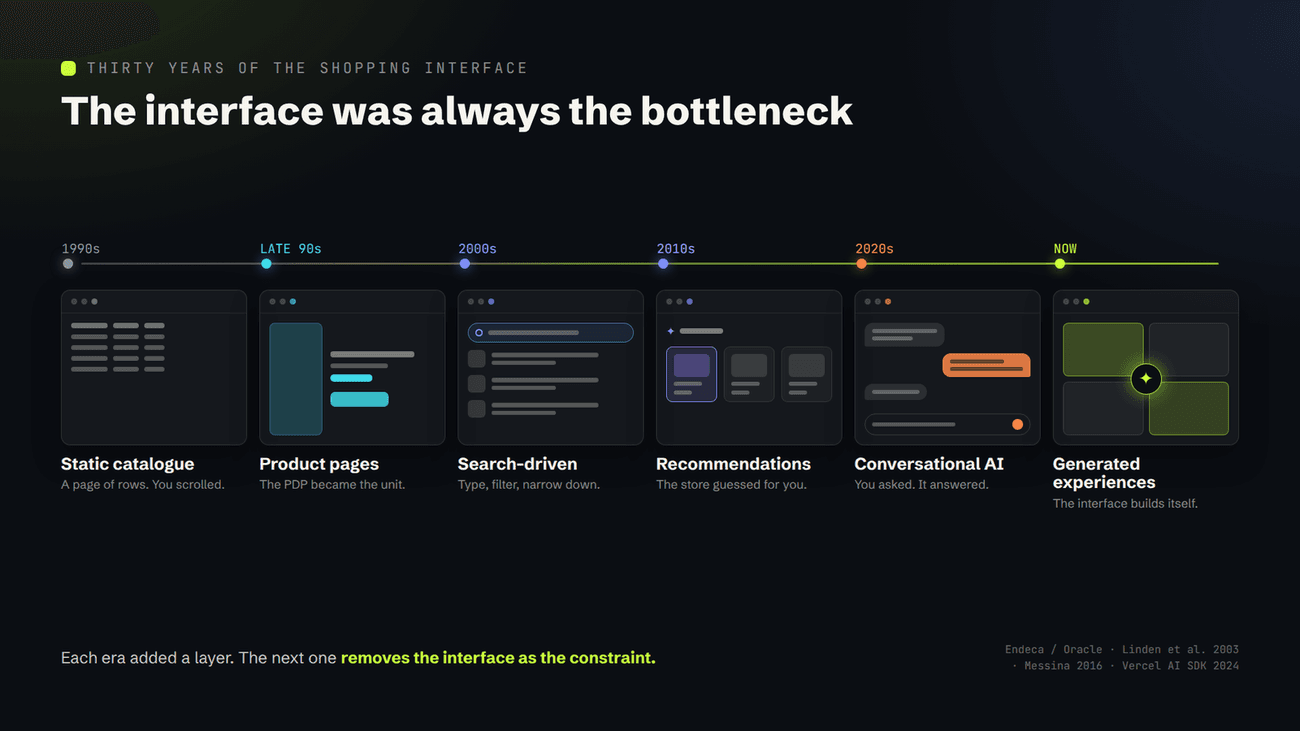
The interface was always the bottleneck. I have been chewing on this for a while, and the more I look at the last thirty years of online shopping, the more it holds up. For as long as we have sold things on the internet, the actual job has never really changed: help someone find the thing they came for. Everything we built on top of that, every redesign and every new feature, was just a different answer to that one question. And the answers kept getting better while the thing underneath stayed exactly the same. You adapted to the interface. It never once adapted to you.
That is finally starting to change, and not in the way the word "chatbot" suggests. So I want to walk through how we got here, what "AI generates the experience" actually means once you strip the marketing off it, where the hype is running ahead of reality, and the unglamorous thing that decides whether any of this works for your store. Spoiler: it is your data, and most stores are not ready.
Thirty years of doing the same job
It helps to see the arc laid out, because each era solved a real problem and then quietly became the floor everyone built on next.
In the early-to-mid 1990s a store was a static catalogue. The first secure consumer transaction on the web was a Sting CD sold through NetMarket in August 1994, and Amazon and eBay both launched in 1995. These were HTML catalogues, rows of products you scrolled through until you found something or gave up. There was no real interaction, just a printed catalogue someone had put on a screen.
Then the product page became the thing that mattered. The PDP turned from a spec sheet into a sales conversation: photos, reviews, social proof, a reason to actually buy. This is also where one of the most stubborn numbers in ecommerce comes from. The average store still converts at roughly two to three percent, and Baymard Institute, which has run cart-abandonment studies since 2006, puts the average abandonment rate at about seventy percent. The product page has had thirty years of optimization and it still leaks like a sieve, mostly over unexpected costs and forced friction at checkout.
The 2000s made search the front door. Endeca, founded in 1999, popularized faceted "guided navigation," rolled it out on Barnes and Noble in 2002, and was acquired by Oracle for over a billion dollars in 2011, which tells you search had gone from clever to mandatory. Shoppers who use on-site search convert at roughly two to three times the rate of those who do not. And yet Baymard still finds that most ecommerce sites have mediocre-or-worse search UX. Mainstream, and still done badly. That pattern repeats in every era.
The 2010s handed it to recommendations. The store stopped waiting for you to look and started guessing. The canonical reference is Amazon's 2003 paper on item-to-item collaborative filtering, the engine behind "customers who bought this also bought." The number everyone quotes, that recommendations drive around thirty-five percent of Amazon's purchases, comes from a single McKinsey article in 2013, not from Amazon itself, so treat it as an estimate rather than gospel. The more defensible figure is McKinsey's own 2021 finding that personalization typically lifts revenue by ten to fifteen percent. Useful, real, and a long way from magic.
Then the 2020s gave us conversational AI. Chris Messina called 2016 "the year of conversational commerce," and the first wave of chatbots mostly underwhelmed. The real shift came after ChatGPT in late 2022, when you could finally just ask, in plain words, and get a straight answer back instead of hunting through a menu.
The layers stacked. The interface never moved.
Here is the part I think gets missed in the breathless versions of this story. None of those eras replaced the one before it. They stacked. Open any decent store today and you have a catalogue, product pages, search, recommendations and a chat box, all running at once. Every era just added another layer on top of the last.
But underneath all of it, one assumption held firm for thirty years: the interface is a fixed thing the merchant builds, and the shopper learns it. You memorized where the filters live. You worked around the quirks of each checkout. You adapted to the store. The store never adapted to you, not really, beyond swapping which products it showed in a fixed grid.
That assumption is the bottleneck. And it is the thing now coming loose.
What "AI generates the experience" actually means
This is where you have to be careful, because "generative UI" gets used for two very different things and the gap between them matters.
The first, and the one actually shipping in production, is an AI that picks and fills in pre-built components. The model does not draw pixels. It decides which of your developer-authored building blocks to show, a product card, a comparison, a size guide, and what data to put in them, usually by calling a tool that returns a component instead of a paragraph of text. Vercel coined the term "generative UI" with its v0 tool in October 2023 and shipped it in the AI SDK in March 2024. The much bigger moment for commerce was OpenAI's Apps SDK in October 2025, which lets third-party apps render interactive UI directly inside ChatGPT, built on top of the Model Context Protocol. Booking.com, Expedia, Canva, Spotify and Zillow were among the first.
The second meaning is the frontier one: the model synthesizes the interface itself, layout and components assembled per request around your intent. Nielsen Norman Group defined this in 2024 as "a user interface dynamically generated in real time by AI to fit the user's needs and context," and was honest that doing it for billions of users is "years, maybe decades" away. Worth noting, even Vercel quietly stepped back from its earliest server-streamed approach and now steers developers toward a more conventional pattern. When the company that coined the term retreats from its first implementation, that is a useful reality check.
So when someone says "the interface builds itself," the honest version today is closer to "an AI assembles a layout from a kit you provided, in context, per shopper," not "an AI invents a brand-new store from scratch every time." The direction is real. The full version is not here yet. Both of those things are true.
Meanwhile, the agents learned to check out
The other half of this is not about how the experience looks but about who is doing the shopping. Increasingly, it is an agent acting for the customer, and 2025 turned into a genuine land grab over the plumbing.
OpenAI launched Instant Checkout in ChatGPT in September 2025, built on the Agentic Commerce Protocol it open-sourced with Stripe, with Etsy live first and Shopify named as next. Google announced its Agent Payments Protocol in September 2025 with sixty-plus partners, then rolled out a Universal Cart across Search, Gemini and YouTube in May 2026, alongside a Universal Commerce Protocol co-developed with Shopify. Perplexity reopened "Buy with Pro" to all US users for free in late 2025 with PayPal as merchant of record. Amazon folded its Rufus assistant into "Alexa for Shopping" in May 2026. Shopify, for its part, announced it was making every store "agent-ready by default."
Here is the table-flattening, hype-puncturing detail that I think tells you exactly where we really are: in March 2026, OpenAI pulled Instant Checkout, saying the first version "did not offer the level of flexibility that we aspire to provide." It had struggled to onboard merchants, show accurate product data, and handle multi-item carts. The leading player shipped the headline feature, then walked it back inside six months and refocused on discovery. That is not a reason to ignore the trend. It is a reason to be precise about the timeline.
The three competing protocols are worth keeping straight, because your platform will likely support one or more of them and the names blur together:
| Protocol | Who is behind it | What it does | Status as of mid-2026 |
|---|---|---|---|
| ACP (Agentic Commerce Protocol) | OpenAI + Stripe | Lets an AI agent complete a purchase with a merchant via a scoped payment token, merchant keeps pricing and fulfillment | Open-sourced 2025; powered ChatGPT Instant Checkout, which was paused in March 2026 |
| UCP (Universal Commerce Protocol) | Shopify + Google | Makes catalogs agent-ready and lets agents assemble a cross-merchant cart | Powers Google's Universal Cart and Shopify "agentic storefronts" |
| AP2 (Agent Payments Protocol) | Google + 60 partners | Payment-agnostic trust layer using cryptographically signed "mandates" so an agent can pay on your behalf | Announced Sept 2025; added autonomous "human not present" buying in 2026 |
The hype, and the honest version
The money forecasts are enormous and you should read every one with the word "projection" stapled to it. McKinsey framed an orchestrated-revenue opportunity of up to one trillion dollars in the US and three to five trillion globally by 2030. eMarketer estimated AI platforms would account for about twenty billion dollars of US ecommerce in 2026, rising toward one hundred forty-four billion by 2029. Gartner, in the same breath as its bullish numbers, predicted that more than forty percent of agentic-AI projects would be cancelled by the end of 2027. These are modeled scenarios with wide ranges and inconsistent definitions, not measured sales.
The measured data is more modest and more interesting. Adobe tracked real referral traffic from AI tools to US retail sites and saw it jump enormously, more than ten times year on year through 2025, but off a tiny base, and those visitors initially converted worse than normal traffic. By the 2025 holiday season the picture had improved sharply, with AI-referred visits converting better than other sources and revenue per visit well up. Salesforce reported that AI "influenced" around twenty percent of orders during Cyber Week 2025. That word, influenced, is doing a lot of work: it means recommendations and chat assistance, not an agent autonomously buying. Most of the headline numbers are AI-referred traffic or AI-influenced sales. True agentic checkout, an agent completing the purchase end to end, is still small, which is exactly what OpenAI's retreat confirms.
So the honest version is this. The interface is genuinely starting to be assembled by AI rather than fixed by you, and agents are genuinely starting to shop on people's behalf. It is early, it is messy, and the first implementations are getting rebuilt in real time. But the direction is not in serious doubt, and the preparation it demands is boring, cheap, and worth starting now.
What this actually means for your store
When a human browses your site, they forgive a lot. They will squint at a vague title, infer that "blue" and "navy" are basically the same filter, and tolerate a missing spec. An AI assembling an experience, or an agent comparing options to make a purchase, forgives none of that. It reads structured data and acts on it. If your product data is thin or messy, you do not show up, or you show up wrong.
This is the unglamorous heart of it. The interface getting generated and the buyer being an agent both push the same conclusion: your clean, structured, machine-readable product data stops being back-office hygiene and becomes the thing that decides whether you exist in this new layer at all.
It is already concrete, not theoretical. OpenAI publishes a product feed spec for ChatGPT with explicit per-product flags for whether an item is eligible to appear in search or be bought in-chat, and supports near-real-time updates. Google's AI shopping reads from its Shopping Graph, which is fed by Merchant Center feeds and schema.org Product and Offer markup, not by crawling your storefront in the moment. Anthropic's Model Context Protocol, open-sourced in November 2024, is becoming the standard way for an AI agent to talk to a store's live data and tools, structured access to your inventory, prices and logic instead of screen-scraping. Shopify now states plainly that "product data quality is the prerequisite for discoverability and conversions in the AI era."
And most catalogs are not ready. The industry has a name for it, "catalog debt": missing attributes, inconsistent taxonomy, duplicates, untagged images, accumulated over years with no clear owner. Gartner has gone as far as predicting that organizations will abandon a large share of AI projects that are not supported by AI-ready data. The work to fix it is not exotic. It is complete attributes, consistent naming, accurate stock and pricing, proper structured markup, and a clean feed. It is just rarely anyone's favorite job, so it does not get done until something forces it.
This is the part where I will be upfront about my own bias, because I work on it. The reason I keep coming back to data is that I have watched it be the actual bottleneck over and over, long before "agentic" was a word. Whatever platform you sell on, the move is the same: get your product and customer data into one clean, structured, machine-readable place, and make sure AI tools and agents can actually reach it. That, plus exposing it over an open standard like MCP so your own assistants and outside agents can query it directly, is exactly what Sellarix is built around. You do not need us specifically to do this. You do need to do it.
The takeaway
For thirty years the job was building a better interface, and we got very good at it, layer after layer, while the basic deal never changed: you build the store, the shopper adapts to it. That deal is the thing now ending. The interface is starting to assemble itself around the person, and sometimes the person is an agent. I would not claim the interface era is over yet, the OpenAI reversal is proof we are early, but you can feel it starting to end.
The good news is that the way to prepare does not require betting on which protocol wins or which assistant people end up using. It requires the least fashionable thing in technology: clean, complete, structured data that a machine can read and act on. Get that right and you are ready for whatever interface shows up next. Get it wrong and the smartest shopping agent in the world will simply skip you, politely, for a competitor whose data it could actually understand.
So the honest question to end on is the one I would ask of my own store: if an AI had to represent your catalog to a customer right now, without a human to smooth over the gaps, would it get you right?
Sources
- The History of the Web - early ecommerce timeline (NetMarket 1994, Amazon and eBay 1995) - https://thehistoryoftheweb.com/expanding-access-the-history-of-ecommerce-part-1/
- Baymard Institute - Cart abandonment rate (70.22%, 50 studies 2006-2025) - https://baymard.com/lists/cart-abandonment-rate
- Baymard Institute - Ecommerce search UX benchmark - https://baymard.com/research/ecommerce-search
- Wikipedia - Endeca (faceted search, Oracle acquisition 2011) - https://en.wikipedia.org/wiki/Endeca
- Linden, Smith and York (2003) - Amazon.com recommendations: item-to-item collaborative filtering - https://www.amazon.science/the-history-of-amazons-recommendation-algorithm
- McKinsey (2013) - How retailers can keep up with consumers (the 35% recommendations estimate) - https://www.mckinsey.com/industries/retail/our-insights/how-retailers-can-keep-up-with-consumers
- McKinsey (2021) - The value of getting personalization right or wrong is multiplying (10-15% lift) - https://www.mckinsey.com/capabilities/growth-marketing-and-sales/our-insights/the-value-of-getting-personalization-right-or-wrong-is-multiplying
- Chris Messina (2016) - 2016 will be the year of conversational commerce - https://medium.com/chris-messina/2016-will-be-the-year-of-conversational-commerce-1586e85e3991
- Vercel (2023) - Announcing v0: generative UI - https://vercel.com/blog/announcing-v0-generative-ui
- Vercel (2024) - AI SDK 3.0: generative UI - https://vercel.com/blog/ai-sdk-3-generative-ui
- Nielsen Norman Group (2024) - Generative UI - https://www.nngroup.com/articles/generative-ui/
- OpenAI (2025) - Introducing apps in ChatGPT and the Apps SDK - https://openai.com/index/introducing-apps-in-chatgpt/
- Stripe (2025) - Stripe and OpenAI: Instant Checkout and the Agentic Commerce Protocol - https://stripe.com/newsroom/news/stripe-openai-instant-checkout
- CNBC (2026) - OpenAI revamps shopping in ChatGPT after Instant Checkout - https://www.cnbc.com/2026/03/24/openai-revamps-shopping-experience-in-chatgpt-after-instant-checkout.html
- Google Cloud (2025) - Announcing the Agent Payments Protocol (AP2) - https://cloud.google.com/blog/products/ai-machine-learning/announcing-agents-to-payments-ap2-protocol
- The Next Web (2026) - Google Universal Cart and agentic shopping at I/O - https://thenextweb.com/news/google-universal-cart-agent-payments-shopping-io-2026
- eMarketer (2025) - US ecommerce sales via AI platforms forecast - https://www.emarketer.com/chart/c/358389/
- McKinsey (2025) - The agentic commerce opportunity - https://www.mckinsey.com/capabilities/quantumblack/our-insights/the-agentic-commerce-opportunity-how-ai-agents-are-ushering-in-a-new-era-for-consumers-and-merchants
- Gartner (2025) - Over 40% of agentic AI projects will be cancelled by 2027 - https://www.gartner.com/en/newsroom/press-releases/2025-06-25-gartner-predicts-over-40-percent-of-agentic-ai-projects-will-be-canceled-by-end-of-2027
- Adobe (2025) - Traffic to US retail sites from generative AI sources - https://blog.adobe.com/en/publish/2025/03/17/adobe-analytics-traffic-to-us-retail-websites-from-generative-ai-sources-jumps-1200-percent
- Salesforce (2025) - Cyber Week: AI agents and sales - https://www.salesforce.com/news/press-releases/2025/12/05/cyber-week-ai-agents-sales/
- OpenAI - Product feed spec for commerce - https://developers.openai.com/commerce/specs/feed/
- Google - Product structured data for Merchant listings - https://developers.google.com/search/docs/appearance/structured-data/product
- Anthropic (2024) - Introducing the Model Context Protocol - https://www.anthropic.com/news/model-context-protocol
- Shopify Enterprise - Agentic-ready product data - https://www.shopify.com/enterprise/blog/agentic-ready-product-data
Ersetzen Sie sechs Tools durch eines
Tragen Sie sich in die Warteliste ein, um zuerst dabei zu sein, oder buchen Sie eine Demo.