Do You Actually Need an ERP? (and at What Size)
There's a spreadsheet on someone's laptop right now that's quietly running an entire ecommerce business. It reconciles inventory across three sales...
The Sellarix team · 10 May 2026 · 5 min read
There's a spreadsheet on someone's laptop right now that's quietly running an entire ecommerce business. It reconciles inventory across three sales channels. It tracks which supplier shipped late. It feeds the numbers that the founder swears are "mostly right." And every month it takes one person two late nights to make it balance. If that's you, you've probably been told you need an ERP. Maybe you do. But I want to push back on the reflex, because ERP is the most expensive answer to a question most stores are asking too early. The honest answer for a lot of you is "not yet," and I'd rather save you $60k than sell you a system you'll resent. Let's figure out which camp you're in.
When spreadsheets and QuickBooks actually stop coping
Here's the thing everyone gets wrong: the trigger isn't revenue. It's complexity. NetSuite's own guidance and a stack of "outgrowing QuickBooks" write-ups land in the same place, there's no magic dollar figure, the real signal is operational pain. That said, the patterns are real. QuickBooks is built for businesses under roughly $10M in revenue and fewer than 20 users. Most ecommerce brands start feeling the squeeze somewhere between $2M and $30M, but the number that matters isn't on the P&L. It's this list:
- You're using spreadsheets to fill gaps your accounting software can't, and core processes now live in those spreadsheets.
- You've crossed ~500 SKUs, or you need lot tracking, serial numbers, or real multi-location inventory.
- Month-end means manual exports, late nights, and endless reconciliation.
- You're adding channels, geographies, or entities and need multi-currency or consolidation.
- You've got more than ~25 users touching the data. If you read that list and felt seen, you're a candidate. If you read it and thought "that's not us yet," then congratulations, the right answer is to keep your money and tighten up what you have.
The contenders (and the cost behind them)
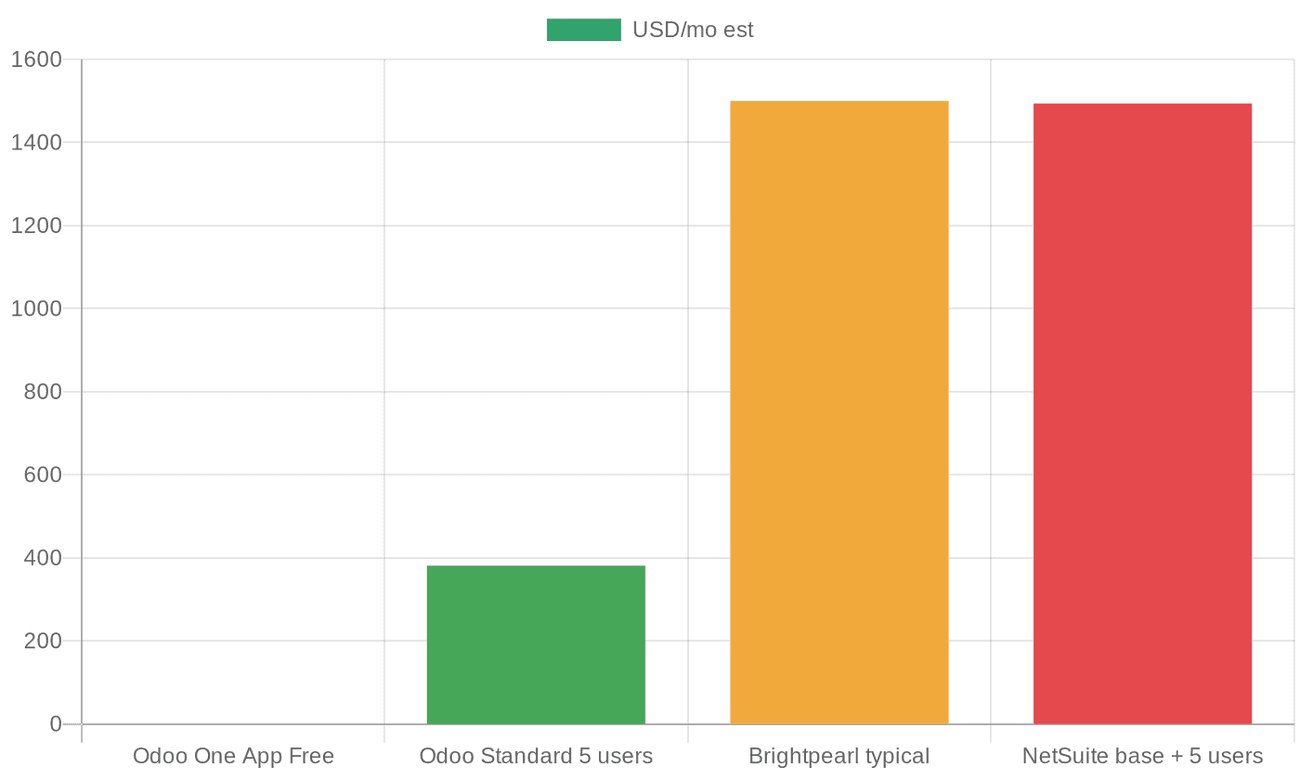
Let's be clear about money first, because the headline price is never the real price. ERP cost is license plus implementation, and implementation is usually the bigger, scarier line. NetSuite's base license starts around $999/month, plus roughly $99–$149 per user per month. Sounds manageable, until implementation, which runs from about $25,000 to $150,000+ depending on complexity. Brightpearl and Odoo play very differently. Here's how the three stack up against the "not yet" option.
| Option | What it does | Price tier (est.) | Complexity | Who it fits |
|---|---|---|---|---|
| "Not yet" (QuickBooks + apps) | Accounting + bolt-on inventory/channel apps | \$ (under \~\$300/mo) | Low | Under \~\$2M, \<500 SKUs, single channel |
| Odoo | Modular open-source ERP, pick the apps you need | $``$ (One App free; Standard \~\$31/user/mo billed yearly, USA) | Low–medium (can grow) | Cost-sensitive SMBs wanting to start small |
| Brightpearl | Retail-specific operating system for multichannel | \$\$\$ (custom quote, \~\$1k–\$3k+/mo + setup) | Medium | \$1M+ multichannel retail, DTC + wholesale |
| NetSuite | Full cloud ERP, multi-entity, global, deep financials | \$\$\$\$ (\$999/mo base + \~\$99–149/user; impl. \$25k–\$150k+) | High | Complex, multi-entity, scaling enterprises |
A few honest notes on each. Odoo is the friendliest entry point. The One App Free tier genuinely costs nothing for unlimited users on a single app, and the Standard plan is around $31 per user per month billed annually (it swings wildly by region, cheaper in some markets, pricier in the US). It's modular, so you bolt on what you need. The trade-off: it can get complex and customization-heavy as you grow, and the bill grows with it. Brightpearl is the one I'd point retail brands toward. It's not a general ERP pretending to do retail, it's a retail operating system built for multichannel ecommerce, wholesale, and physical stores. It targets $1M+ merchants and prices by order volume on a custom quote. If your pain is inventory and order management across channels, this is purpose-built for it. NetSuite is the heavyweight. It's the answer when you've genuinely got multi-entity, multi-currency, global complexity. It's also the most expensive and the most involved to implement, first-year all-in can land between $50k and $100k+. It's overkill for a single-channel DTC brand, and right for a company consolidating across regions.

How I'd actually decide
Run this in order.
- Name the pain, don't name the revenue. "We close the books in five days of manual work" is a reason. "We hit $5M" is not.
- Count your SKUs and channels. Under 500 SKUs and one or two channels? You can almost certainly solve this with better apps on QuickBooks.
- If it's a retail/inventory problem, look at Brightpearl before NetSuite. Don't buy a global ERP to fix an order-management headache.
- If you're cost-sensitive and curious, start with Odoo's free app. It's the lowest-risk way to test whether ERP-style workflows even help you.
- Only reach for NetSuite when complexity, multi-entity, multi-currency, deep financials, is the actual problem. That's what you're paying the premium for. And whatever you pick, separate development from production. Pilot it on a sandbox, migrate data in a dry run, and don't flip your live operations over until the new system has survived a real month-end. One more thing worth saying: a chunk of what pushed brands toward heavy ERP, channel syncing, inventory truth, clean reporting, is increasingly handled by AI-native commerce platforms before you ever need a six-figure system. If you're not yet at true multi-entity complexity, it's worth seeing how far a modern stack like Sellarix gets you before you sign an ERP contract.
The takeaway
An ERP is a tool for managing complexity you actually have, not complexity you're worried about having. Buy it too early and you'll spend $60k and six months automating a business that a $200/month app could've run. Buy it too late and you'll lose a person to spreadsheet purgatory. The skill is knowing which line you're standing on. So, real question: if you listed every process your business runs in a spreadsheet today, would that list justify an ERP, or just a better afternoon cleaning up the tools you already have?
Sources
- Top 12 Signs That You're Outgrowing QuickBooks, NetSuite
- NetSuite Pricing Guide 2025, Closeloop
- Odoo Pricing, official
- Odoo Pricing 2025: Standard vs Custom Plans Explained, ThinkTech
- Brightpearl Pricing, official
- Top 7 NetSuite Alternatives, Brightpearl
- NetSuite vs Odoo ERP Comparison, Gurus Solutions
- Photo: Tiger Lily via Pexels
Replace six tools with one
Join the waitlist to be first on the platform, or book a demo.