Build vs Buy vs Hire: When to Bring In a Developer or Agency
You've got a problem in your store. Checkout is leaking. Your product feed is a mess. You need a bundle feature that no app quite does right. And now...
The Sellarix team · 19 May 2026 · 5 min read
You've got a problem in your store. Checkout is leaking. Your product feed is a mess. You need a bundle feature that no app quite does right. And now you're staring at the same fork in the road every operator hits eventually: do I patch this myself, install an app, hire a freelancer, bring in an agency, or just put someone on payroll? I've made this call from most of those chairs, and I've made it badly more than once. The first time I needed a custom integration I hired the cheapest freelancer I could find, paid him twice (once to build it, once to have someone else fix it), and learned an expensive lesson about what "affordable" actually costs. So this isn't a vendor pitch. It's the decision tree I wish someone had handed me.
The thing nobody tells you about "just build it"
Here's the stat that should make everyone pause before commissioning custom work. The Standish Group's CHAOS research, which tracks tens of thousands of software projects, found waterfall-style builds succeed only about 13% of the time, while agile projects land around 42%.[1] Large projects succeed less than 10% of the time. Let that sink in. The default outcome of custom software is not success. It's challenged-or-cancelled. Forrester's work (cited widely in build-vs-buy frameworks) puts a finer point on it: a large share of failed implementations trace back to getting the build-vs-buy call wrong in the first place, not to bad code.[2] The decision is the project. The coding is downstream. Meanwhile the "buy" side has gotten genuinely good. The Shopify App Store now lists somewhere north of 11,000 to 17,000 apps depending on whose count you trust, and the average merchant runs around 6 apps.[3] Most problems you think are special have been solved by someone else for $20 a month. That's not a knock on your problem. It's just the math of a mature ecosystem. So before you spend a dollar, ask one question: is this thing core to how I make money, or is it plumbing? Plumbing you buy. Core, defensible, this-is-why-customers-pick-me stuff might be worth building. Everything else is a distraction wearing a roadmap.
What each option actually costs
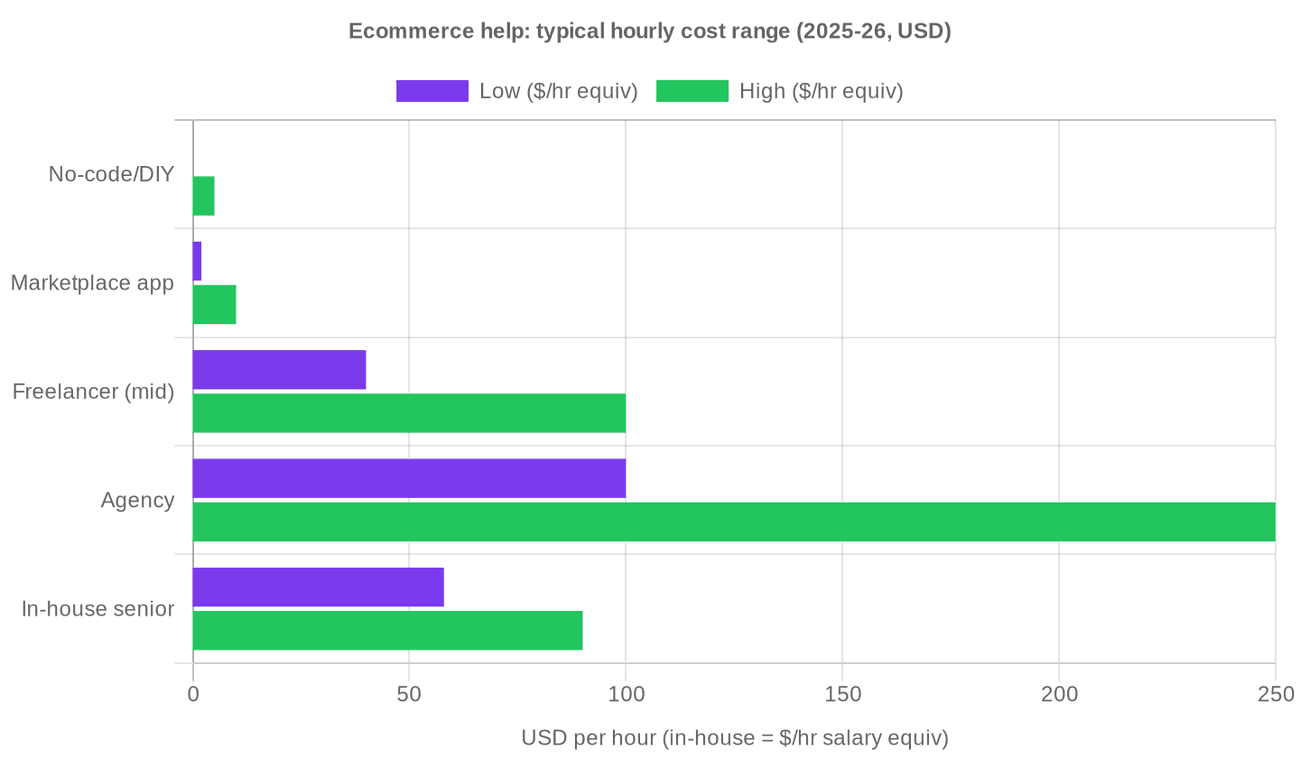
Let me put real numbers on the five paths. Freelance Shopify devs run roughly $40 to $100 an hour for solid mid-level people, with juniors lower and top specialists past $150.[4] Agencies typically bill $100 to $250 an hour because you're paying for a team, a project manager, and someone to call when it breaks.[5] A from-scratch custom build at enterprise scale is a $100k-to-$500k-plus animal once you count hosting, DevOps and the maintenance tail.[6]
| Option | Best for | Cost | Speed | Risk | Who it fits |
|---|---|---|---|---|---|
| No-code / DIY | Quick fixes, landing pages, simple automations | \$0-\$50/mo tools + your time | Hours to days | Low cost, high opportunity cost | Founders, solo operators |
| Marketplace app | Common, well-defined needs (reviews, upsell, feeds) | \~\$10-\$120/mo each | Same day | Low, but app sprawl + lock-in | Almost everyone, start here |
| Freelancer | Scoped one-off builds and tweaks | \$40-\$150/hr | Days to weeks | Medium: key-person, continuity | Lean teams with clear specs |
| Agency | Multi-part projects, replatforms, design+build | \$100-\$250/hr | Weeks to months | Lower delivery, higher spend | Funded brands, complex scope |
| In-house hire | Ongoing core IP, constant iteration | \$120k-\$180k+/yr senior | Slow to start, fast after | High fixed cost, hiring risk | Scaled stores with a roadmap |
How to actually read that table
Speed and risk pull in opposite directions, and that's the whole game. No-code and apps are fast and cheap but you hit a ceiling, and when you hit it you've often built a Frankenstein of six apps fighting each other. Freelancers are the sweet spot for a clean, scoped job, but they introduce key-person risk: if your one developer goes quiet, your feature goes with them. I've been ghosted mid-project. It's not fun. Agencies cost the most per hour and they're worth it precisely when the project is big enough that delivery risk dwarfs hourly rate. Buying non-core functionality can cut time-to-market by around 60% versus building from zero, and formal decision frameworks correlate with roughly 40% better project outcomes.[6] An agency buys you that process. The trap is using one for a job a $60/hr freelancer could finish in a week. In-house only makes sense past a break-even point. For mid-market firms, custom builds often don't beat SaaS subscriptions on total cost until around month 33.[2] If your need won't outlive three years of iteration, a salaried developer is the wrong tool. Hire when the work is permanent, central, and never-done.
My rule of thumb
Climb the ladder, don't skip it. Try no-code, then an app, then a freelancer, then an agency, then a hire. Move up a rung only when the current one demonstrably can't do the job, and write down why. Most stores never need to climb past rung two, and the ones that blow their budget almost always jumped straight to four or five because custom felt more serious. Serious is shipping the fix this week. The real cost was never the hourly rate. It was the months you lost backing the wrong horse. So here's my question for you: the thing you're about to commission a build for, are you certain it's core, or does it just feel important because it's annoying you right now?
Sources
- Storetasker, Shopify Developer Rates 2025: https://resources.storetasker.com/blog/shopify-developer-rates-the-real-cost-of-hiring-a-shopify-freelancer-or-agency-in-2025
- Upwork, Cost to Hire a Shopify Developer: https://www.upwork.com/hire/shopify-developers/cost/
- Appinventiv, Build vs Buy 2026 cost & ROI: https://appinventiv.com/blog/build-vs-buy-software/
- HatchWorks, Build vs Buy framework: https://hatchworks.com/blog/software-development/build-vs-buy/
- Standish CHAOS via Mersino/Medium, agile vs waterfall success rates: https://medium.com/leadership-and-agility/agile-project-success-rates-are-2x-higher-than-traditional-projects-376a05e590d4
- Uptek, Shopify App Store statistics 2026: https://uptek.com/shopify-statistics/app-store/
Remplacez six outils par un seul
Rejoignez la liste d'attente pour etre parmi les premiers, ou reservez une demo.