How to Get Your Products Recommended by ChatGPT and AI Shopping Agents (2026 Guide)
AI now recommends one product, not ten links, and ranking #1 on Google no longer puts you in the answer. Here is exactly how AI shopping agents choose, and the 22-point playbook to make them pick your store.
Something has quietly changed about how people shop online, and most store owners have not clocked it yet. For twenty years, search handed you a page of blue links and you chose. Now a fast-growing share of shoppers ask an AI, and the AI chooses for them. One answer, not ten links. And if your product is not that answer, you may as well not be there.
This is the complete, practical guide to fixing that. By the end you will know exactly how AI shopping agents decide what to recommend, the 22 specific things to do so they recommend you, how to measure it, and the honest risks nobody selling you "AI visibility" likes to mention. Every number here is sourced, and a few popular claims you have probably seen get corrected along the way.
Let us start with why this is urgent, not theoretical.
Table of contents
- The old SEO playbook is detaching from AI search
- Where the money is actually going
- Meet the six AI shopfronts (with a comparison table)
- How an AI agent actually picks a product
- The 22-point AI visibility checklist
- Letting the AI crawlers in (reference table)
- How to measure AI traffic
- The honest caveats
- A note for UK stores
- Do these five things this week
- FAQ
- Sources
1. The old SEO playbook is detaching from AI search
Here is the statistic that should make you sit up. In February 2026, Ahrefs analysed 863,000 keywords and four million AI Overview URLs and found that only about 38% of the sources AI cites also rank in Google's top ten for the same query. Seven months earlier that overlap was 76% [1]. BrightEdge's separate tracking puts the overlap even lower, at around 17% [1].
Read that again. The thing you have spent years and money on, ranking on page one of Google, is rapidly decoupling from whether an AI recommends you. It is a different game with different rules, and the gap is widening by the month.
At the same time, industry estimates put the share of shoppers using AI assistants to help them buy at around 70%, and a large proportion of AI answers are "zero-click", meaning the AI answers without ever sending the shopper to a website [2]. If the AI resolves the question without you in the answer, you do not even get the chance to compete on your own site.
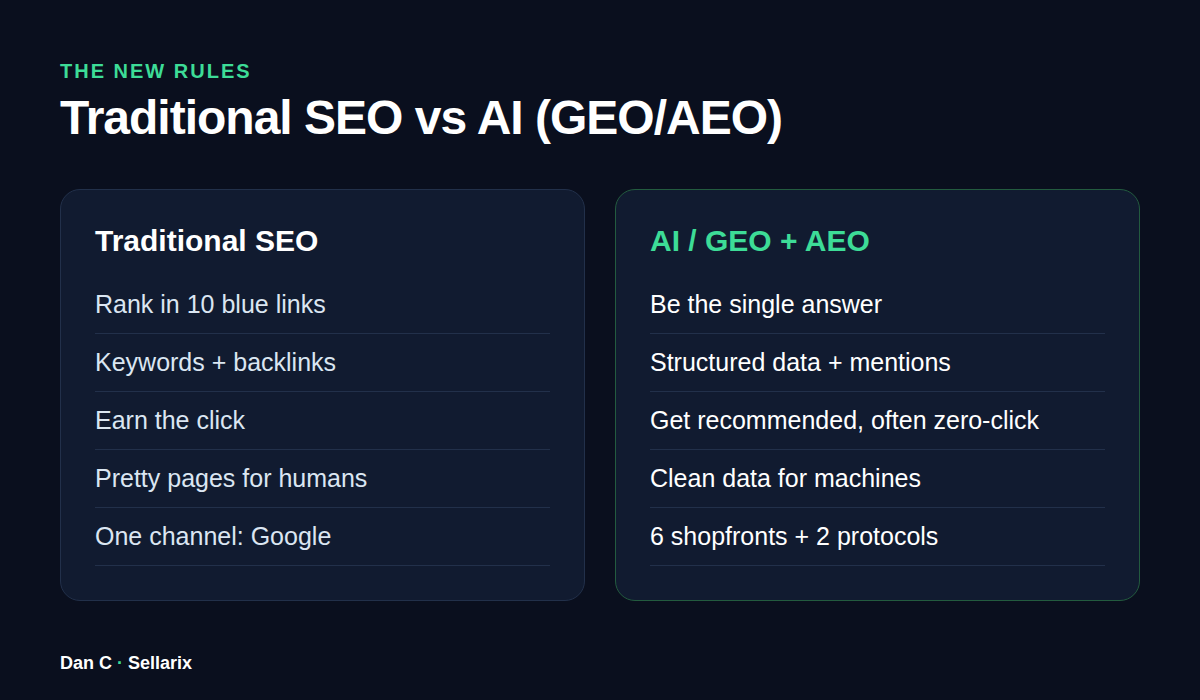
This new discipline has two overlapping names you will see used interchangeably: GEO (Generative Engine Optimisation) and AEO (Answer Engine Optimisation). Both mean the same thing in practice: structuring your products, content and reputation so an AI can confidently extract, trust and recommend you. Here is how the mindset differs from classic SEO.
| Traditional SEO | AI search (GEO / AEO) | |
|---|---|---|
| Goal | Rank in the ten blue links | Be the single recommended answer |
| Main levers | Keywords, backlinks, on-page | Structured data, brand mentions, reviews |
| The win | Earn the click | Get recommended, often with zero click |
| You optimise for | Humans skimming a page | Machines parsing your data |
| Where it happens | Mostly Google | Six shopfronts, two open protocols |
| Who can win | Whoever has authority and budget | Whoever has the cleanest, most trusted data |
That last row is the good news for smaller brands. You cannot buy your way into an AI recommendation the way you buy Google Ads. You earn it with data quality and trust, which is effort, not budget.
2. Where the money is actually going
This is not a fringe behaviour with no money behind it.
- Bain expects AI-led shopping to be worth $300 to $500 billion in the US alone by 2030, roughly 15 to 25% of all ecommerce [3].
- McKinsey puts the global figure at $3 to $5 trillion by 2030, with around $1 trillion of that in the US [4].
- Morgan Stanley pegs the agentic commerce impact at around $385 billion by 2030 [5].
The firms differ because each draws the line around "agentic" in a different place (McKinsey's figure includes B2B, logistics and payments), but the direction of travel is not in dispute.
And it is already landing in real stores today. Shopify, which has more first-party visibility into this than almost anyone, reports:
- AI-driven traffic up around 8x year on year, and orders from AI search up about 15x, as of April 2026 [6].
- AI-referred shoppers convert about 50% higher and spend roughly 14% more per order than people arriving from ordinary search [7].
That second point matters most. These are not tyre-kickers. They are among your best customers, and most stores cannot even see them yet.
3. Meet the six AI shopfronts
When people say "AI shopping" they usually picture ChatGPT. But there are six places worth knowing, and two open standards sitting underneath them. Here they are side by side.
| Shopfront | Who feeds it | How you get in | Checkout today | UK status |
|---|---|---|---|---|
| ChatGPT | Agentic Commerce Protocol (OpenAI + Stripe); Shopify and Etsy auto-integrated | Product feed or supported platform | Discovery is the durable prize; in-chat checkout scaled back Mar 2026 | "Coming to the UK" |
| Google AI Mode + Gemini | Google Merchant Centre feed (the Shopping Graph) | A live Merchant Centre feed. No feed, no presence | Universal Cart rolling out, US first | UK further back in queue |
| Shopify Agentic Storefronts | Shopify Catalog | On by default for eligible US merchants; Agentic Plan for non-Shopify | Shopify Checkout, attributed to the AI channel | US first |
| Amazon Alexa for Shopping (ex-Rufus) | Amazon catalogue + Buy for Me | Be a strong Amazon listing | Native + "Buy for Me" off-platform | Rolling out |
| Perplexity | Merchant Program (structured catalogue) | Submit a catalogue; reviews weigh heavily | Citation-led | Available |
| Microsoft Copilot | Shopify Agentic Storefronts channel | Via the Shopify setup | Embedded checkout | Rolling out |
Sources: OpenAI and Stripe [8][9]; Google [10][11][12]; Shopify [6][13][14]; Amazon [15]; Perplexity [16][17].
Two takeaways. First, Google's Merchant Centre feed is the single highest-leverage asset here: without it you simply do not exist in Google's AI shopping. Second, you do not need to learn the underlying protocols (ACP from OpenAI and Stripe, UCP from Google and Shopify). You need your product data ready for them.
4. How an AI agent actually picks a product
This is the part that changes how you work day to day. An AI agent does not look at your nicely designed homepage. It reads your data, and it checks three things in order [18].
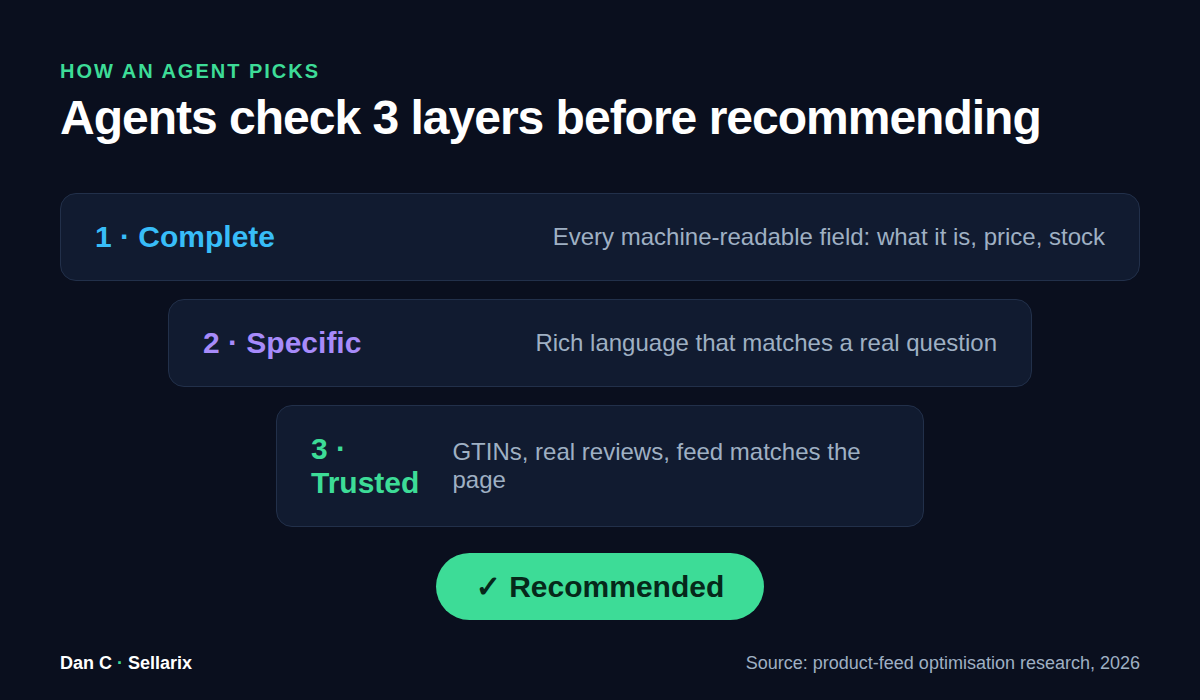
- Is the record complete? Enough machine-readable fields to know what the product is, what it costs, and whether it is in stock.
- Is it specific? Language rich enough to match a natural question like "best waterproof walking boots under 120 pounds".
- Can it be trusted? Barcodes (GTINs), genuine reviews, accurate shipping, and a feed that matches your on-page data.
The clearest way to understand it is to see what the machine sees. Same product, two records.
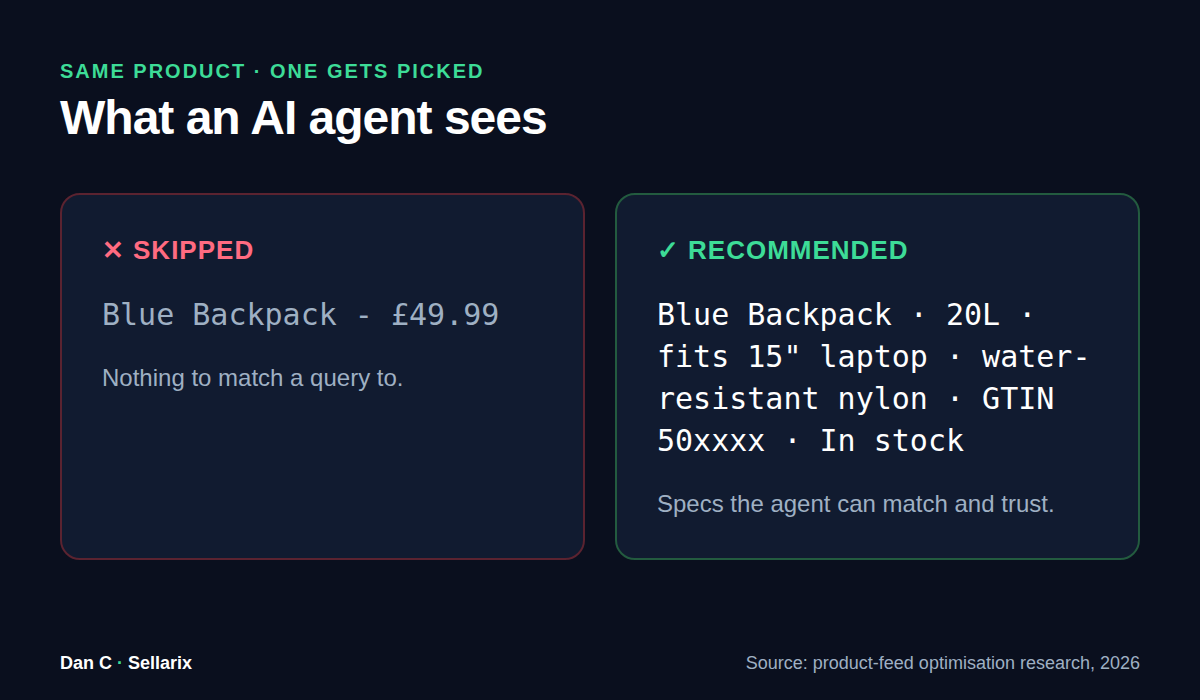
| Weak record | Strong record | |
|---|---|---|
| Title | Blue Backpack | Blue Backpack, 20L commuter |
| Price | £49.99 | £49.99, in stock |
| Detail | none | Water-resistant nylon, fits 15" laptop, 20 litres, 600g |
| Identifiers | none | GTIN, brand, category |
| Trust | none | 4.6 stars, 312 reviews |
| Agent outcome | Skipped, nothing to match | Recommended and surfaced |
The product is identical. The data is not. That difference is the whole game.
5. The 22-point AI visibility checklist
Here is the work, grouped into seven jobs (A to G). Most of it is effort rather than ad spend, which is precisely why a focused smaller brand can out-rank a lazy big one. Use the priority and effort columns to sequence it.
| Job | What it covers | Effort | Impact |
|---|---|---|---|
| A. Feeds | Get found at all | Medium | Very high |
| B. Schema | Eligibility + modest edge | Low | Medium |
| C. Copy | Match real questions | Medium | High |
| D. Formatting | Get cited more | Low | Medium |
| E. Trust + mentions | Be the trusted pick | High | Very high |
| F. Crawler access | Stop blocking yourself | Low | Critical |
| G. Brand control | Stop the guessing | Low | Medium |
A. Product data and feeds (the foundation)
- Get a clean Google Merchant Centre feed live. Without it you are absent from AI Mode [12].
- If you are on Shopify, confirm Agentic Storefronts is enabled; if not, look at the Agentic Plan to reach the AI channels without replatforming [14][13].
- Submit a structured catalogue to Perplexity's merchant programme [16].
- Keep inventory and pricing accurate in real time. Agents deprioritise stale or uncertain data [12][18].
- Populate GTINs and full attributes: material, dimensions, compatibility, use case [18].
B. Structured data (necessary, not magic)
- Add complete Product schema with populated fields. Be realistic here, because this is where most advice oversells. The best controlled study (Fischman, 730 AI citations) found pages with populated Product or review schema were cited somewhat more often than generic schema, 61.7% versus 41.6%, about a 1.5x edge. But a separate Ahrefs test of 1,885 pages found that adding schema on its own barely moved AI citations [19]. So do it for eligibility and a modest edge, then move on. Anyone selling schema as a one-click route to AI recommendations is overselling it.
- Add Offer schema for price and AggregateRating for reviews, and keep all of it consistent with your feed [19][18].
C. Conversational, specific copy
- Rewrite descriptions in a Benefit + Proof + Spec pattern. For example: "Professional results in ten minutes (verified by 2,000 lab tests) using a 400W motor" [20].
- Replace vague claims like "premium quality" with specifics: materials, dimensions, who it is for [S20].
- Use conversational attributes that mirror how people actually ask an assistant [11].
D. Formatting for machines
- Use clear headings, bullets, numbered lists and comparison tables. Amsive found content with consistent heading levels was about 40% more likely to be cited by ChatGPT, and roughly 80% of ChatGPT-cited articles contain a list, against 28.6% of Google's top results [21].
- Build a real FAQ from the questions customers actually ask in reviews and support tickets [S20].
- Structure pages around the questions, using them as your H2 and H3 headings [20].
E. Trust, reviews and off-site presence
- Surface your reviews. Agents lean on them heavily, Perplexity especially [17].
- Build off-site brand mentions through PR, roundups, directories and communities. Ahrefs studied 75,000 brands and found unlinked brand mentions correlate with AI visibility about three times more strongly than backlinks (0.664 versus 0.218), and Muck Rack found around 82% of AI-cited links come from earned media [22].
- Get into third-party "best of" and comparison articles. That is what the agents synthesise from when they build a recommendation [S20].
F. Technical access for AI crawlers
- Allow the AI search crawlers in your robots.txt. Block them and none of the above works [23].
- Understand that training bots and search bots are different, so blocking one does not affect the other [23].
- Treat llms.txt as navigation help, not access control. The crawler operators do not honour it as a gate [24].
G. Brand control
- Use a verified knowledge base (Shopify has an app) so agents quote your real policies, shipping and voice instead of guessing [6].
- Keep that knowledge base and your feed in sync as products and policies change [6][12].
- Audit what the agents say about you now. Ask ChatGPT, Gemini and Perplexity to recommend products in your category and see if you appear, and whether they get you right.
6. Letting the AI crawlers in
Point 17 is the one that silently kills everything else, so it deserves its own reference. If your robots.txt blocks the search crawlers, you cannot be cited no matter how good your data is. Note the split between training bots and search bots, they are different jobs from the same companies [23].
| Bot | Company | Job | Sensible default for a shop |
|---|---|---|---|
| OAI-SearchBot | OpenAI | Powers ChatGPT live search | Allow |
| GPTBot | OpenAI | Trains models | Allow (helps brand recall) |
| PerplexityBot | Perplexity | Search and retrieval | Allow |
| Google-Extended | Training opt-out token | Your policy call | |
| ClaudeBot / Claude-SearchBot | Anthropic | Train / search | Allow search |
A reasonable default for most stores: allow the search and retrieval crawlers everywhere, and make a deliberate policy decision on the training crawlers [24].
7. How to measure AI traffic
You cannot improve what you cannot see, and almost nobody is looking yet. That is your edge.
GA4 added a native AI Assistant channel in May 2026, but it only recognises ChatGPT, Gemini and Claude, so Perplexity and Copilot stay buried in Referral [25]. Build a custom channel group with a simple regex and you will see the full picture:
chatgpt.com|chat.openai.com|gemini.google.com|claude.ai|perplexity.ai|copilot.microsoft.com
Then track your share of voice in AI answers over time. Google's Merchant Centre now has a share-of-voice tool for exactly this [S20][11]. Early data suggests AI-referred visitors can convert far above organic search, though figures vary widely by sector and study, so treat any single benchmark as illustrative rather than a promise [26].
8. The honest caveats
I am not going to pretend this is finished or risk-free [27][28].
- Loss of control. Agents can misrepresent your product or quote the wrong spec.
- Price commoditisation. An agent optimising purely on price can erode a brand premium.
- Structured-data bias. Models tend to favour brands with richer data. That is earnable, but it is real.
- Returns risk. Wrong specs lead to wrong purchases and more returns, especially in electronics.
- An accountability gap. When an agent buys or triggers a refund, the rules on liability and fraud are still being written.
None of this is a reason to sit it out. It is a reason to go in clear-eyed and keep your data tight.
9. A note for UK stores
Most of this launched in the US first. ChatGPT Shopping is described as coming to the UK, and Google's Universal Cart has the UK further down the rollout, with some shopping features available only on request in the UK and Europe [29].
Do not let that become an excuse to wait. The groundwork, your feed, schema, product data, reviews and crawler access, is country-agnostic and pays off today. Do it now and you are not waiting for the rollout, you are at the front of the queue when it lands. The brands that prepare during the quiet stretch are the ones that look like they appeared overnight later.
10. Do these five things this week
If you do nothing else:
- Get a clean Merchant Centre feed live [12].
- Confirm Agentic Storefronts, or set up the Agentic Plan [14].
- Allow the AI search crawlers in robots.txt [23].
- Rewrite your top ten product descriptions in Benefit + Proof + Spec [20].
- Build the GA4 AI channel so you can measure it [26].
That is the difference between being found by the machines that are about to do a great deal of the shopping, and being invisible to them.
11. FAQ
What is the difference between GEO, AEO and SEO? SEO gets you ranked in Google's links. GEO (Generative Engine Optimisation) and AEO (Answer Engine Optimisation) are effectively the same thing: getting an AI to extract, trust and recommend you in its answer. The overlap with SEO is shrinking, only about 38% of AI citations now also rank top-10 on Google [1].
Do I need to be on Shopify to appear in ChatGPT? No. Shopify and Etsy catalogues are auto-integrated, which is convenient, but brands on any platform can use Shopify's Agentic Plan or submit feeds directly. The non-negotiable is a clean, structured product feed [13][8].
Is schema markup enough to get recommended by AI? No. Schema is necessary for eligibility and gives a modest edge (around 1.5x in one controlled study), but Ahrefs found adding schema alone barely moved citations [19]. The bigger levers are specific copy, reviews and off-site brand mentions.
How do AI shopping agents choose which product to recommend? They read your structured data and check three things: is the record complete, is it specific enough to match the query, and can it be trusted (GTINs, reviews, feed-page consistency) [18].
Does this work in the UK yet? The groundwork does and should be done now. Some buy-now features are US-first, with the UK further back in the rollout [29].
How do I see if AI is already sending me traffic? Build a custom channel in GA4 using a regex for the AI domains, because GA4's native channel misses Perplexity and Copilot [25][26].
Are AI shoppers actually worth it? Shopify reports AI-referred shoppers convert around 50% higher and spend about 14% more than ordinary search visitors [7].
What is the single most important first step? A live Google Merchant Centre feed. Without it you cannot appear in Google's AI Mode at all [12].
Sources
- Ahrefs, AI Overview citations vs top-10 (Feb 2026)
- BigCommerce, Ecommerce GEO 2026
- Bain, 2030 agentic AI retail forecast
- McKinsey, agentic commerce $3-5tn
- Morgan Stanley, agentic commerce market impact
- Shopify, How agentic commerce works
- Shopify, AI-referred shoppers convert better
- OpenAI, Buy it in ChatGPT (ACP)
- Stripe, Instant Checkout + ACP
- Google, Universal Commerce Protocol
- Google, Universal Cart + agentic shopping
- Google Merchant Centre as canonical feed
- Shopify, Millions of merchants can sell in AI chats
- Shopify Agentic Storefronts launch
- Amazon, Alexa for Shopping (ex-Rufus)
- Perplexity Merchant Program
- HubSpot, ChatGPT product recommendations
- Product-feed optimisation for AI agents
- Fischman, schema vs AI citation study
- Yotpo, AEO for ecommerce
- Search Engine Land / Amsive, LLMO formatting
- Ahrefs, brand mentions vs backlinks (75k brands)
- OpenAI crawler documentation
- robots.txt + llms.txt for AI crawlers
- MarTech, GA4 AI Assistant channel
- Tracking AI traffic in GA4
- Agentic commerce risks (Sanbi/Stord)
- TLT, agentic commerce legal frontier
- Fast Company, AI shopping race (UK availability)