Do Loyalty Programs Pay Back? The Retention Maths, the Accounting Nobody Mentions, and What the Research Says
Smile.io starts free and reaches $999 a month. LoyaltyLion starts at $199. The academic evidence says most programs mostly reward people who were staying anyway. Here is how to tell which case you are in.
A points program is a discount you've agreed to give in the future, to people you can't identify yet, at a rate you set before you knew what it would cost.
That's not a criticism. It's just the actual shape of the thing, and it explains why so many loyalty programs feel fine for a year and awkward after two.
Let's do this with published prices, the academic evidence, and the accounting treatment nobody puts in a pitch deck.
What the research actually says, and it's uncomfortable
The Ehrenberg-Bass Institute has published extensively on loyalty and the finding is consistent enough to be inconvenient. Byron Sharp's position, stated plainly: "loyalty schemes have very little impact on the behaviour of regular customers. If you operate one, you're mainly rewarding guests who would have stayed with you anyway." And: "The impact of customer loyalty is definitely overestimated."[1]
The institute's broader work on growth points the same direction, that brands grow mainly by acquiring new buyers rather than by squeezing existing ones[2].
This is a genuine academic institute with no product to sell you, which is worth noting because almost every other statistic you'll read on this topic comes from a loyalty vendor's annual report.
The counter-argument, stated fairly
Ehrenberg-Bass work is drawn heavily from repertoire categories: FMCG, hotels, airlines, banks. Categories where buyers routinely use several brands. Their conclusions are strongest there.
Ecommerce loyalty programs often do something different. They're less about changing preference and more about changing where a purchase happens. A customer who would have bought a similar product on Amazon buys it from you instead because they have points. That's a channel shift, not a loyalty shift, and it can be genuinely valuable without contradicting a word Sharp says.
So my honest position: the research is right that loyalty programs rarely manufacture loyalty. They can still be worth running as a channel-retention and margin-management tool, and you should evaluate them as that rather than as a relationship-building exercise.
Does this actually impact you? Three qualifying questions
1. Is your product replenishable?
Consumables, subscriptions, anything with a natural repurchase cycle. If yes, a program has something to reward. If you sell mattresses, points have almost no mechanism to work through.
2. Is your repeat rate already above about 20%?
Counterintuitive but important. A program amplifies an existing behaviour, so it works best where repeat purchasing already happens. Under 20%, a loyalty program is a discount for one-time buyers who will not return, which is the most expensive way to lose money slowly.
3. Can your margin absorb the reward rate?
If you offer 1 point per £1 and 100 points is worth £5, that's a 5% discount on everything, applied later, to your best customers. On a 60% gross margin that's tolerable. On 25% it's most of your profit.
Two nos out of three and the answer is no.
What we found: the pricing ladders are steeper than they look
Read on 22 July 2026 from the vendors' own pages.
Smile.io publishes everything
| Plan | Price | Included orders/month |
|---|---|---|
| Free | $0 | 200 |
| Essential | $15/mo | 500 |
| Standard | $79/mo | 1,000 |
| Growth | $199/mo | 2,500 |
| Plus | $999/mo, billed annually | 7,500 |
| Enterprise | Custom, annual | Unlimited |
Source: Smile.io pricing page, accessed 22 July 2026. Higher tiers carry overage rates for additional volume[3].
LoyaltyLion publishes the entry point
Classic at $199 a month including 500 orders. Advanced and Plus are listed as custom, with an order-volume slider running from 500 to over a million, and the FAQ referencing base order caps of 2,000 on Classic, 4,000 on Advanced and 10,000-plus on Plus for some existing customers[4].
The finding
Look at those two tables together. At 500 orders a month, Smile.io is $15 and LoyaltyLion is $199. That is a thirteen-fold difference for the same order volume, and it tells you these products are aimed at different buyers despite appearing in the same comparison articles.
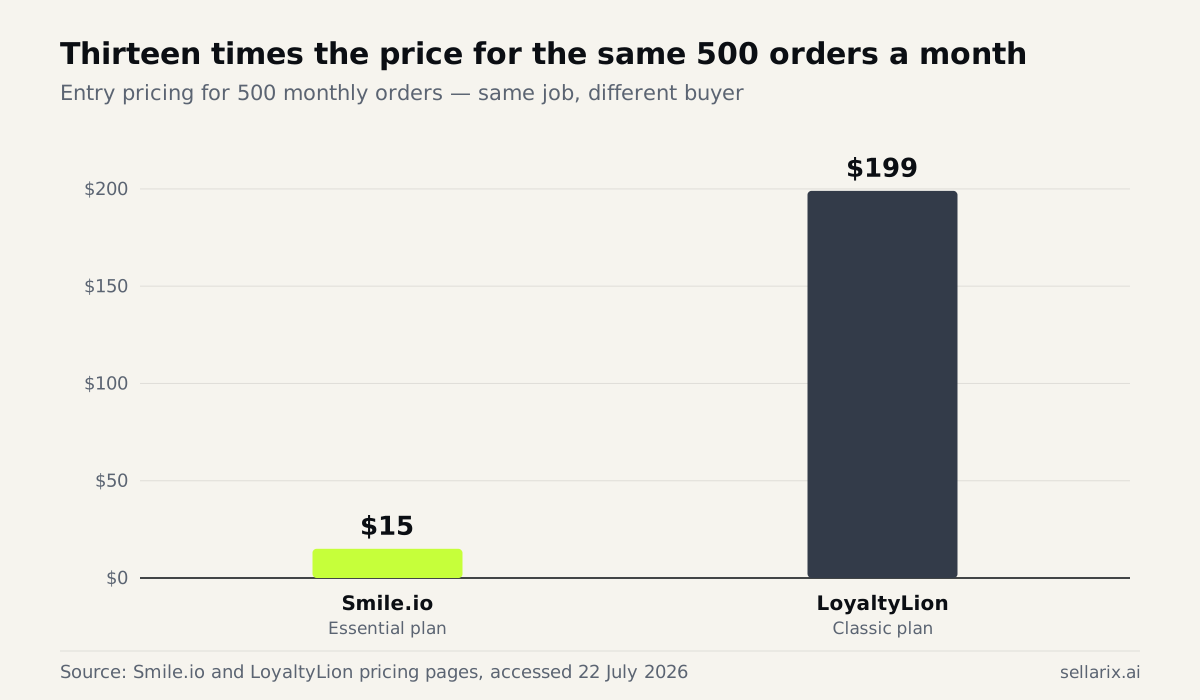
Smile.io is priced as an app. LoyaltyLion is priced as a program with strategic support attached. Neither is wrong. But if you're comparing them on features, you're comparing the wrong axis, and if a comparison article puts them side by side without mentioning that gap, it's probably an affiliate page.
Yotpo and Stamped both bundle loyalty with reviews, which changes the maths again and introduces the suite risk I'd flag anywhere[5][6]. Yotpo previously sunset its Email and SMS products and moved that customer base to Attentive[7], which is a reminder that a bundle can be unbundled by the vendor and you inherit the migration. We covered that pattern in the reviews tools piece.
The accounting nobody mentions in the demo
This is the section I'd want a finance person to read, and it's absent from essentially all loyalty marketing.
Unredeemed points are not free money you got away with. Under IFRS 15 and its US equivalent, loyalty points awarded with a sale are typically a separate performance obligation. You allocate part of the transaction price to them and defer that revenue until the points are redeemed or expire[8][9].
What that means in practice
Three consequences that catch people out.
Your recognised revenue is lower than your gross sales by the value allocated to points issued. Your balance sheet carries a contract liability that grows as long as issuance outpaces redemption. And breakage, meaning points that will never be redeemed, is recognised in proportion to the pattern of redemption rather than claimed upfront, unless you have solid historical data to support an estimate[9].
For a small store this is immaterial and your accountant will wave it through. For anyone approaching a funding round, a sale, or an audit, an unmodelled loyalty liability is exactly the sort of thing that turns up in diligence at the worst moment.
The expiry decision is a real decision
Point expiry is where the accounting, the customer experience and the law all meet. Expiring points reduces your liability and annoys customers. Not expiring them means the liability accumulates forever. Whatever you choose, the terms need to be clear at the point of earning, not discovered at the point of redemption. Consumer protection regulators take a dim view of the reverse.
The unit economics, as a model you can fill in
This is the artefact. Nine rows, one honest answer.
| # | Line | How to get it |
|---|---|---|
| 1 | Baseline repeat rate | % of customers ordering twice in 12 months, before the program |
| 2 | Average order value | Your real AOV, not the good month |
| 3 | Gross margin % | After COGS and shipping subsidy |
| 4 | Reward rate | Value of points issued as % of order value |
| 5 | Expected redemption rate | Start at 25% and revise with your own data |
| 6 | Effective discount | Row 4 x row 5 |
| 7 | Platform cost per month | From the tables above[3][4] |
| 8 | Required repeat-rate lift | What lift makes rows 6 and 7 back? |
| 9 | Is row 8 believable? | Given row 1 and the research[1] |
Row nine is the whole exercise. If you need a 9-point lift in repeat rate to break even and your baseline is 12%, you're betting on close to doubling repeat purchase from a points program, which the research says is not a thing that reliably happens[1].
The measurement problem, stated plainly
Every loyalty dashboard will tell you members spend more than non-members. That comparison is worthless. Your best customers join loyalty programs because they're your best customers. Selection, not causation.
The only honest measurement is a holdout: a randomly assigned group that can't join, compared over a full purchase cycle. Which means experimentation discipline is the prerequisite for knowing whether your program works. Most stores never run it, and vendors have little reason to suggest it.
The alternative most people should look at first
Subscriptions beat points where they fit
If your product is genuinely replenishable, a subscription does everything a points program claims to do and does it better. It locks in the repeat purchase directly rather than incentivising it indirectly, it makes forecasting possible, and the discount is explicit rather than accruing invisibly on your balance sheet. The subscriptions piece covers the mechanics and the churn maths.
The catch is that subscriptions only work where consumption is predictable. Nobody subscribes to a coat.
Or fix the post-purchase experience instead
A working replenishment email at the right interval outperforms most points programs and costs a fraction of one. That's a flow in your ESP, not a platform purchase, and the email and SMS piece covers where it sits in the flow audit.
Or fix the reason people don't come back
Which is usually the product, the delivery time or the returns experience rather than the absence of points. Discounting your way past a delivery problem is expensive and doesn't work twice.
If you are on Shopify
The app ecosystem is the deepest here
Smile.io and LoyaltyLion both have mature Shopify listings and the integration is the reason most merchants pick one of them[10][11]. Free tiers exist, which makes trialling genuinely cheap[3].
Check the discount mechanism
Loyalty redemptions become discount codes or price rules, and those interact with your other promotions in ways that are easy to get wrong. Stacking a loyalty redemption on top of a sale price on top of free shipping is how a £60 order arrives at £22. Set combination rules explicitly.
Watch the checkout extension
Redemption at checkout is where these apps add the most friction and the most latency. Test the mobile checkout with a real device before and after installing anything.
Not on Shopify? The other platforms
WooCommerce
Plugin territory with wide quality variance, and this is the platform where I'd most seriously consider building a simple version yourself. A points balance is a customer meta field, an earn rule is a hook on order completion, and a redemption is a coupon. That's a few days of work against a stable REST API[12], and it avoids a monthly fee that scales with your order count forever.
The catch is that you then own it. Read orders through the API rather than the database, because High-Performance Order Storage changed where they live[13].
Magento and Adobe Commerce
Adobe Commerce includes reward points and store credit natively, with configurable earn rules, exchange rates and redemption at checkout[14]. That's one of the few places where the enterprise licence gives you something others bill monthly for.
Read the small print though. Reward points is an Adobe Commerce feature and is not in Magento Open Source[14]. Open Source merchants are back in extension territory. If you're on Adobe Commerce and paying a third party for points, go and check what you already own before your next renewal, and while you're there set the exchange rate deliberately rather than leaving the default[21].
BigCommerce
Store credit and gift certificates natively, third-party apps for full points programs, clean APIs to build against[15].
Headless
Loyalty is one of the easier things to own in a headless stack because it's mostly a ledger. Get the earn and burn rules into a service with tests, and don't let the point balance live in two places. Headless stores are undercounted in every platform statistic you'll read[16].
What agents change about loyalty
An awkward one for the category.
Points work through emotional accounting. You have a balance, the balance feels like yours, and losing it feels bad. That mechanism needs a human who remembers the balance exists.
An assistant comparing products on price, availability and delivery date has no such attachment. Unless your points balance is exposed as structured data that the agent can factor into an effective price, it's invisible to the decision. The emerging commerce protocols describe price, availability and fulfilment as structured fields, and there's no established loyalty-balance primitive in them[17][18].
How much does this matter today? Very little. ChatGPT accounts for under 0.2% of ecommerce traffic in Kaiser and Schulze's peer-reviewed work across 973 sites[19], though Shopify reports AI-referred orders up roughly 13 times year on year[20].
The direction is worth noting though. If purchase decisions increasingly get made by software that doesn't feel loss-averse about your points, the psychological mechanism the whole category rests on gets weaker. Not this year. Possibly this decade.
What to do this week
- Calculate your baseline 12-month repeat rate. Before anything else. It decides the answer.
- Work out your effective discount. Reward rate times expected redemption rate.
- If you already run a program, pull redemption rate and outstanding point balance. The second one is a liability[9].
- Ask your accountant how points are treated in your accounts. If the answer is "they aren't", that's the finding[8].
- Check your discount combination rules. Loyalty plus sale plus free shipping is where margin disappears.
- If you're on Adobe, check whether you're paying for reward points you already have[14].
- Set up a holdout group. Even a small one. It's the only way you'll ever know.
The takeaway
The strongest independent research says loyalty programs mostly reward people who were staying anyway[1]. The pricing runs from free to $999 a month at Smile.io and starts at $199 at LoyaltyLion for the same 500 orders[3][4]. And the points you issue are a liability on your balance sheet, not a marketing expense[9].
None of which means don't run one. It means run it as a margin decision with a holdout, on a product with a repurchase cycle, and stop calling it loyalty.
I ran a points program for two years and reported member spend against non-member spend in every monthly update. It looked wonderful. It was measuring which of my customers were already good, and I knew that and reported it anyway because the chart went up.
What's your repeat rate among customers who never joined? Do you even have that number?
Sources
- Ehrenberg-Bass Institute for Marketing Science, "About loyalty", featuring Byron Sharp. Independent academic institute. Accessed 22 July 2026.
- Ehrenberg-Bass Institute, "Effective brand growth: acquisition or retention?". Accessed 22 July 2026.
- Smile.io, "Pricing". Free/200 orders, $15/500, $79/1,000, $199/2,500, $999 annual/7,500, Enterprise custom. Accessed 22 July 2026. Vendor page.
- LoyaltyLion, "Pricing". Classic $199/month including 500 orders; Advanced and Plus custom. Accessed 22 July 2026. Vendor page.
- Yotpo, "Pricing". Accessed 22 July 2026. Vendor page.
- Stamped, "Pricing". Accessed 22 July 2026. Vendor page.
- Yotpo, press room. Source for the Email and SMS sunset and Attentive transition. Accessed 22 July 2026.
- IFRS Foundation, "IFRS 15 Revenue from Contracts with Customers". Primary standard.
- IFRS Community, "Customer loyalty programmes (IFRS 15)". Treatment of loyalty points as contract liabilities and breakage. Accessed 22 July 2026.
- Smile.io, Shopify App Store listing. Accessed 22 July 2026.
- LoyaltyLion, Shopify App Store listing. Accessed 22 July 2026.
- WooCommerce, "REST API". Accessed 22 July 2026.
- WooCommerce, "High-Performance Order Storage". Accessed 22 July 2026.
- Adobe, "Reward and loyalty programs". Adobe Commerce documentation. Note: reward points is an Adobe Commerce feature, not available in Magento Open Source. Accessed 22 July 2026.
- BigCommerce, "Customers API". Accessed 22 July 2026.
- HTTP Archive, "Web Almanac 2025: Ecommerce". Accessed 22 July 2026.
- Google, "Under the Hood: Universal Commerce Protocol (UCP)". Google Developers Blog.
- Agentic Commerce Protocol, specification repository. Maintained by OpenAI and Stripe.
- Maximilian Kaiser and Christian Schulze, "ChatGPT Referrals to E-Commerce Websites", Marketing Science. Peer-reviewed; 973 sites, $20B revenue.
- Shopify, financial reports, Q1 2026. AI-referred orders up roughly 13x YoY.
- Adobe, "Reward exchange rates". Adobe Commerce documentation. Accessed 22 July 2026.