100 Ways to Use AI to Increase Your Ecommerce Conversions (2026)
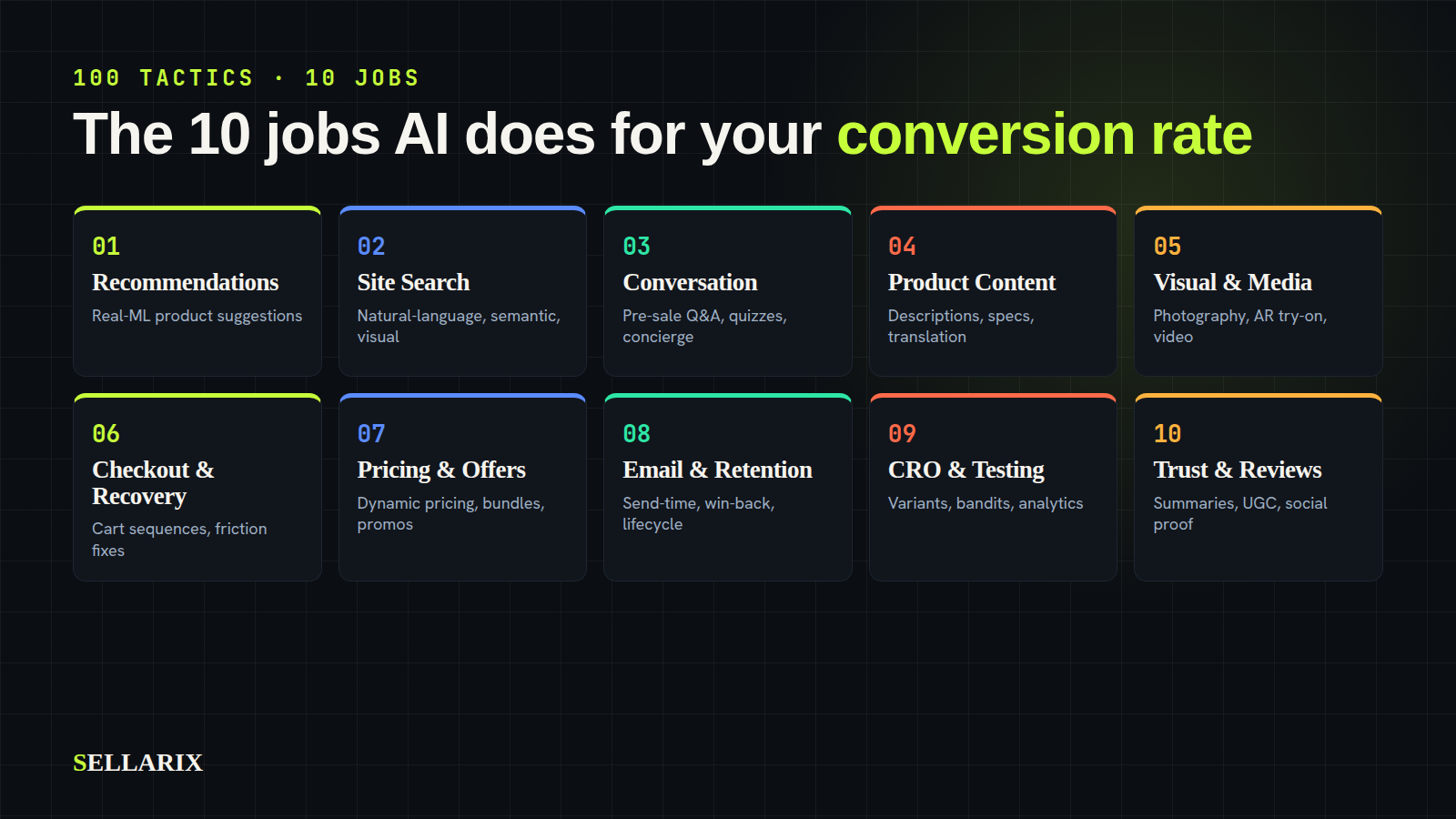
Most stores chase more traffic when the money is in the visitors they already paid for and watched leave. Here are 100 specific ways to use AI to lift conversion, grouped into 10 jobs, each with the how, not just the idea.
Here is the uncomfortable truth about most ecommerce growth plans: they chase more traffic when the real money is in the traffic you already paid for and watched leave. The average store converts roughly 2 to 3 percent of visitors, and Baymard's rolling average of 50 studies puts cart abandonment at 70.22%, with around $260bn in recoverable sales lost every year in the US and EU to checkout alone [1].
That gap is where AI earns its keep, as a conversion layer: helping people find the right product, answering the question that was about to lose the sale, rebuilding the abandoned cart, and proving the thing is worth buying. Shopify's data shows AI-referred shoppers convert about 50% higher [2], and Zoovu's 2026 benchmark across 3 million interactions found shoppers who engage AI assistance are about 25% more likely to convert [3].
This is the catalogue: 100 specific ways to use AI to lift conversion, grouped into 10 jobs, and each one comes with the how: the method and the kind of tool you'd actually use, not just the idea. You will not do all 100. Read it like a menu: find where your store leaks and start there. There is an honest "hype versus real" section near the end too, because most of the eye-watering stats online do not survive contact with a source.
Note on tools: named tools below are examples to show the category, not endorsements or the only option. Pick what fits your stack and budget.
1. Personalisation and recommendations
AI recommendations are commonly cited as driving 15 to 35% of ecommerce revenue [6], and personalisation lifts revenue around 10 to 25% on conservative measures [6]. The trick is relevance from real behaviour, not random "bestsellers".
- "You may also like" from real behavioural ML. Stop hand-picking. Deploy a recommendation engine (Shopify Search & Discovery, Nosto, Rebuy, or LimeSpot) that trains on your order and clickstream data, and place the widget on the PDP below the buy box and in the cart.
- Personalised category-page ordering. Re-rank product grids per visitor so the items most likely to convert for them sit top-left. Use a personalisation engine (Nosto, Algolia Recommend) and start with returning/logged-in users where you have signal.
- A personalised homepage. Swap hero rails and featured collections based on the visitor's affinities and last session. Implement with your personalisation platform's "slots", with a sensible default for first-timers.
- Cart cross-sell ("complete the look"). Show genuinely complementary items at the cart/drawer using co-purchase data, not random upsells. Rebuy or Shopify's native bundles do this; cap it at 2-3 suggestions so it helps, not clutters.
- Recently-viewed and "pick up where you left off". Persist browsing across sessions and surface it on return. Most personalisation apps include this; it quietly recovers considered purchases.
- Post-purchase recommendations. The thank-you page is the highest-intent moment you have. Add a one-click "add to your order" rail (Rebuy, AfterSell) with items that pair with what they just bought.
- Recommendations inside email and SMS. Inject live, personalised product blocks into Klaviyo/Omnisend flows so every send merchandises to the individual, not the list.
- Affinity bundles auto-generated from data. Let AI assemble bundles from real co-purchase patterns and price them as a set. Test against manual bundles; the data usually wins.
- Cold-start recommendations for new visitors. With no history, blend trending, high-converting and context (landing page, source, geo). Configure a fallback strategy in your recs engine so first-timers still see relevant picks.
- Real-time intent recommendations. React within the session: if someone filters by "waterproof", shift recs to waterproof. Needs an engine with real-time signals (Nosto, Dynamic Yield) rather than nightly batch.
2. AI site search and discovery
Site-search users convert at roughly 2 to 3x the site average [5], yet most stores run keyword search that dies on a typo. Fixing search is one of the highest-ROI moves available.
- Natural-language search. Let people search "waterproof jacket for dog walking under 80" and get the right result. Swap native search for an AI search app (Algolia, Klevu, Searchspring, or Shopify Search & Discovery with semantic add-ons).
- Typo, plural and synonym tolerance. "Trainers" must find "sneakers". Configure synonym dictionaries and enable fuzzy matching in your search tool, then feed it your real query log.
- Semantic / vector search. Match meaning, not just keywords, so "office party dress" finds the right styles. Use a vector-search-capable engine (Algolia NeuralSearch, Klevu) that embeds your catalogue.
- Visual search. Let shoppers upload or tap a photo to find similar products. Add a visual-search module (Syte, Vue.ai, or Google Vision-backed), strong for fashion and homeware.
- A "no results" rescue page. Never show a dead end. Configure fallbacks that suggest near-matches, popular items and a "did you mean", so a failed search still converts.
- Search-as-you-type with previews. Show product thumbnails, prices and categories in the dropdown as they type. Standard in Algolia/Klevu; it shortens the path to PDP.
- Query understanding (attribute parsing). Parse colour, size, price and use-case from the query and apply them as filters automatically. Enable "query categorisation" / NLP in your search platform.
- Merchandised search results. Boost in-stock, high-margin and best-selling items in results, and bury out-of-stock. Set merchandising rules in your search tool tied to inventory and margin feeds.
- Voice search. Support spoken queries on mobile and assistant surfaces; lean on the same NLP layer as natural-language search.
- Mine search analytics for catalogue gaps. Your zero-result and high-exit searches are a shopping list of demand you can't fulfil. Review the search analytics weekly and stock or redirect accordingly.
3. Conversational AI: chat and guided selling
Engaged shoppers convert markedly higher than passive ones [3][10]. A good assistant answers the pre-sale question that would otherwise lose the sale, at 11pm, in any language.
- Pre-sale product Q&A grounded in your data. Deploy an AI chat (Gorgias AI, Tidio Lyro, Zoovu, or a Shopify-connected assistant) that answers from your real specs, stock and policies, not generic waffle. Feed it a verified knowledge base so it doesn't hallucinate.
- A guided-selling quiz. Turn a sprawling range into one confident recommendation with a 3-5 question quiz (Octane AI, Zoovu). Brilliant for supplements, skincare, tech, anything with choice paralysis.
- Size and fit advice. The biggest conversion blocker in fashion. Add a fit-finder (True Fit, Fit Analytics, or Kiwi Sizing) that recommends a size from a couple of inputs; it lifts conversion and cuts returns.
- An AI concierge that can act. Let chat search, compare and add to cart, not just talk. Use an assistant with commerce actions wired to your store API.
- Proactive chat on hesitation. Trigger a helpful prompt after long dwell or repeated scroll on a PDP. Configure behavioural triggers in your chat tool; keep it useful, not naggy.
- Clean handoff to a human. Route complex or high-value queries to a person with full context. Set escalation rules so the AI handles volume and humans handle nuance.
- Multilingual chat. Convert international traffic by answering in the shopper's language automatically, most modern AI chat does this natively.
- Commerce in WhatsApp, Instagram and Messenger. Meet shoppers where they already are. Connect a conversational-commerce platform (Gorgias, Tidio, Charles) to your social inboxes with product lookup and checkout links.
- An assistant that builds the cart. Let the bot assemble a cart and hand off a one-tap checkout link, turns a conversation straight into an order.
- 24/7 cover. Ensure the late-night and weekend browser gets answered instantly; that's a large slice of traffic that otherwise bounces unhelped.
4. AI product content
Thin copy kills conversions and now hides you from AI search too. AI fixes catalogue content at scale, if you keep it specific.
- Auto-write descriptions (Benefit + Proof + Spec). Generate copy in that structure ("dries in 10 minutes, tested 2,000 times, 400W motor") with an AI writer wired to your product data (Hypotenuse, Describely, or a custom GPT). Always feed real specs in.
- SEO titles and meta descriptions. Generate keyword-aware titles/metas per product at scale, then spot-check the top sellers by hand.
- Spec sheets into scannable bullets. Convert dense manufacturer specs into clean, skimmable bullet lists, AI is excellent at this reformatting job.
- Auto-tag and fill attributes. Use AI to populate missing material, fit, use-case and GTIN fields across the catalogue; clean attributes power filters, search and AI shopping feeds.
- Fill catalogue gaps in one pass. Batch-generate the descriptions for the thousands of SKUs nobody ever got round to writing. Prioritise by traffic.
- Translate and localise. Generate native-quality copy per market with AI translation tuned to your brand glossary, not literal machine translation.
- Enforce one brand tone. Run all copy through a tone/style pass so 5,000 products read like one brand. Define a style prompt once and apply it.
- PDP FAQs from real questions. Mine reviews and support tickets with AI to auto-build the FAQ that answers the actual objections losing you sales.
- Auto comparison content. Generate "X vs Y" tables and "which is right for you" copy between similar products to help the undecided choose (and stay on-site).
- Conversational, question-shaped copy. Add copy phrased the way people ask AI assistants, so you're quotable in AI search as well as readable on-page (see the AI-shopping-agents guide).
5. AI visual and media
People buy what they can picture owning. AI makes rich media affordable, and better visuals both lift conversion and cut returns [7].
- AI product photography and clean-up. Generate or enhance on-white and lifestyle shots at catalogue scale (Pebblely, Claid, Photoroom) instead of booking a studio for every SKU.
- Lifestyle / scene generation. Place products in context (the lamp in a styled room, the bag on a city street) with AI scene tools, context sells.
- On-model visualisation across body types. Show apparel on diverse models without endless shoots (Lalaland, Botika), so more shoppers see themselves in it.
- 3D and AR try-on. Let shoppers try eyewear, makeup, furniture or clothing virtually (Vue.ai, Style3D, Fibbl, Snap AR). Strong conversion lift and lower returns where it fits.
- Automatic background removal and consistent framing. Batch-standardise every image so the catalogue looks coherent (Photoroom, remove.bg APIs).
- Product video from stills. Turn existing photos into short motion clips for PDPs and ads with AI video tools, movement holds attention.
- UGC-style video ads at volume. Generate authentic-feeling video creatives (Arcads, Creatify) to test angles fast for paid and social.
- Image SEO and alt text. Auto-generate descriptive alt text and filenames so images are accessible and discoverable.
- Colour and variant swaps. Recolour a product across its variants without reshooting each one.
- A consistent visual style across the catalogue. Apply one look (lighting, crop, background) everywhere with batch AI editing, so the store feels premium and trustworthy.
6. Checkout and cart recovery
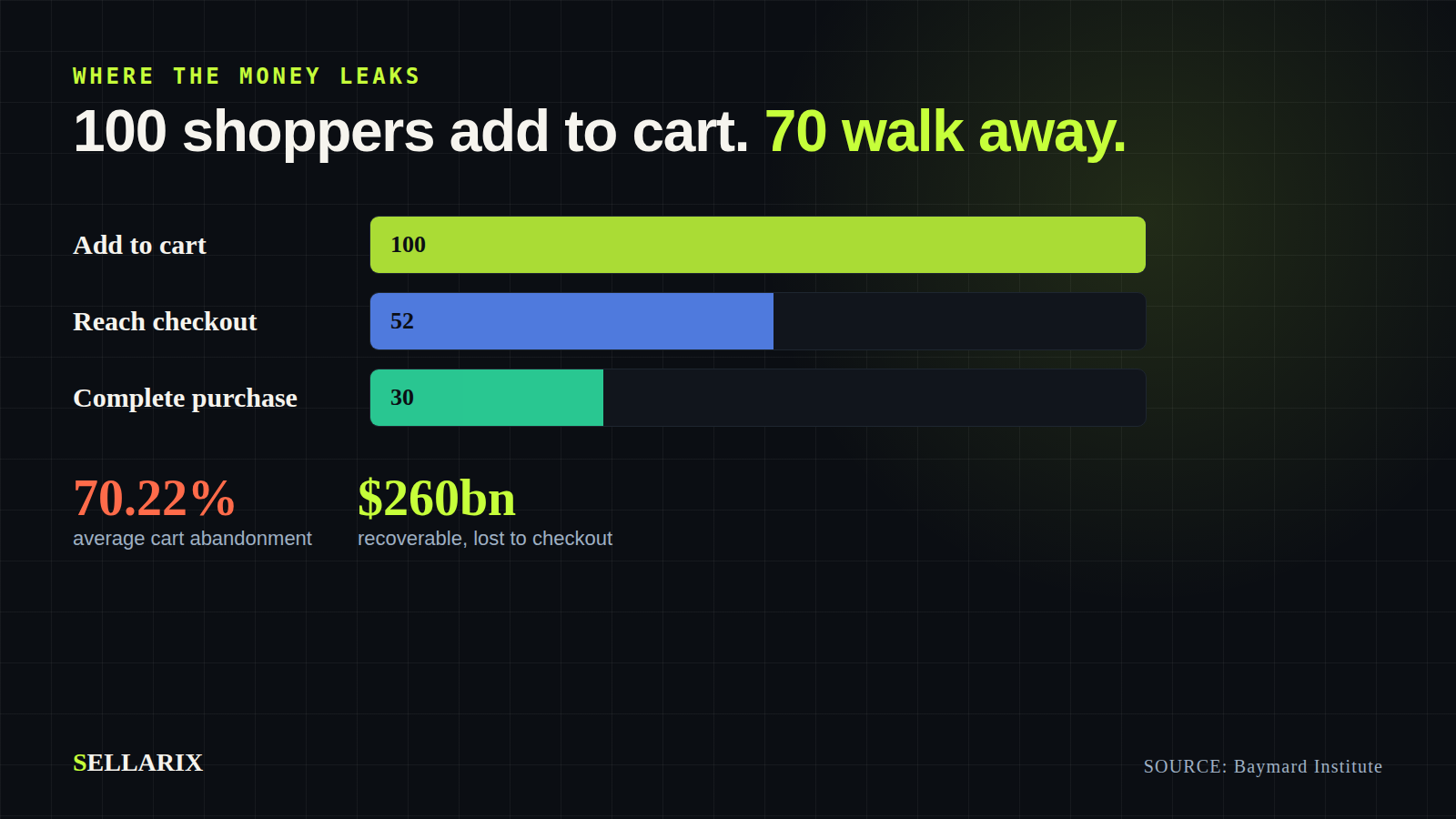
This is where the 70% leaks out [1]. Personalised recovery converts around 2.5x generic, and offers matched to the cart convert 6 to 10% versus 2 to 4% for generic popups [9].
- AI cart-abandonment sequences. Run multi-step email + SMS + push flows that reference the exact items left behind. Build them in Klaviyo with AI-written, AI-timed messages; 3 messages recover meaningfully more than 1 [9].
- Exit-intent offers matched to the cart. Trigger a relevant nudge (not a blanket 10%) when someone moves to leave, matched to cart value and contents.
- One-click and express checkout. Turn on Shop Pay, Apple Pay and Google Pay, fewer fields, far fewer drop-offs. The single easiest checkout win.
- Address autocomplete and validation. Add Google/Loqate autocomplete to kill typing friction and failed deliveries.
- Smart fraud scoring. Use AI fraud tools (Shopify's, Signifyd) that block genuinely bad orders without rejecting good buyers (false declines are lost sales).
- Dynamic shipping and returns messaging. Surface free-shipping thresholds, delivery dates and easy returns at the cart, since extra cost is the No.1 abandonment reason [1].
- AI-optimised send timing for recovery. Let the platform send each recovery message when that person is most likely to open and buy.
- Generated, tested recovery copy. Auto-generate subject lines and body variants and let the system pick winners.
- Smart discounting (only when needed). Use AI to detect who actually needs an incentive to convert, so you stop discounting people who'd have bought anyway and protect margin.
- Personalised post-abandon retargeting. Feed dynamic product ads the exact abandoned items with copy tuned to them.
7. AI pricing and offers
Pricing is the fastest lever to revenue. McKinsey puts dynamic pricing at sales growth of 2 to 5% and margin growth of 5 to 10% [4].
- Dynamic pricing within margin guardrails. Let an AI pricing tool (Intelligems, Prisync, Competera) adjust prices within hard floors you set; never hand it the keys without guardrails.
- Price testing. A/B test actual price points (Intelligems) to find real willingness-to-pay instead of guessing.
- Personalised promotions. Target offers to segments that need them (lapsed, price-sensitive) rather than blanket sitewide codes that train everyone to wait for a sale.
- AI-optimised bundle pricing. Model the bundle discount that maximises take-up without gutting margin.
- Free-shipping-threshold optimisation. Use AI to set the threshold that lifts average order value most for your basket distribution, and surface progress ("£12 to free shipping").
- Markdown and clearance optimisation. Let AI time and size markdowns to clear stock while protecting margin, instead of flat end-of-season cuts.
- Competitor-aware repricing. Where you compete on identical SKUs, reprice against the market automatically within your floors (Prisync).
- Psychological price points. Apply charm pricing and anchoring (show the higher reference price) guided by test data.
- Subscription and tiered pricing. Model subscription discounts and tiers on cohort behaviour to maximise lifetime value, not just first order.
- "Price drop" and "lowest in 30 days" nudges. Notify shoppers when a watched item drops, and show honest price-history context to create confidence and urgency.
8. AI email, SMS and retention
Conversion isn't only the first order. AI lifecycle marketing converts repeat intent cheaply; abandoned-cart sequences alone add roughly 24% to monthly revenue on average [9].
- Predictive send-time. Let Klaviyo/Omnisend send each subscriber when they're most likely to open and buy.
- Product recommendations in every flow. Inject live personalised recs into welcome, browse, post-purchase and win-back emails.
- Churn prediction → automated win-back. Score who's about to lapse and trigger a tailored win-back before they go quiet.
- Replenishment reminders. Time "running low?" messages to each product's consumption cycle (coffee, skincare, supplements), high-intent, high-converting.
- Self-updating AI segmentation. Let segments rebuild themselves as behaviour shifts, instead of static lists that rot.
- Generated, tested subject lines and copy. Use AI to draft and A/B test subject lines and body at volume.
- Personalised loyalty offers. Tailor rewards and perks to each member's behaviour to drive the next order.
- Back-in-stock alerts. Capture demand on sold-out items and convert it the moment stock returns.
- Browse-abandonment flows. Re-engage people who viewed but never added to cart, a bigger pool than cart-abandoners.
- Full lifecycle automation. Wire welcome → nurture → post-purchase → replenish → win-back so the machine works every stage while you sleep.
9. AI CRO and experimentation
AI both finds the problem and tests the fix. Baymard found a large site can gain a 35.26% conversion lift from better checkout design alone [1].
- Generate test variants fast. Spin up dozens of headline, CTA and layout variants with AI in minutes (then test them, don't just ship them).
- Multi-armed bandit testing. Use bandit allocation (built into many CRO tools) to shift traffic to winners automatically, faster than classic A/B.
- AI heatmap and session analysis. Let tools (Hotjar AI, Microsoft Clarity) summarise where people rage-click, hesitate and drop, so you fix the real friction.
- Predictive CRO. Estimate the revenue impact of a change before you build it (Evolv, Shoplift) and prioritise by expected return.
- Auto-personalised landing pages. Match the page to the ad/source/intent automatically so the message stays consistent from click to convert.
- Page-speed and Core Web Vitals fixes. Use AI audits to find and fix what's slowing pages; every second of delay costs conversions. Start with images and scripts.
- Continuously-tested PDP copy. Let AI rewrite and test product-page copy on a loop, keeping the winning version live.
- Form and field optimisation. Cut and reorder checkout fields based on where people abandon; fewer fields, more orders.
- Mobile-first fixes. Mobile is most of your traffic and most of your abandonment [1], fix tap targets, sticky add-to-cart and mobile speed first.
- Plain-English analytics insights. Use AI analytics (GA4 insights, Triple Whale) to get "here's why conversion dropped" instead of dashboards nobody reads.
10. Trust, reviews and social proof
In an AI-saturated web, genuine proof is what converts. Northwestern's Spiegel Research Center found a product with just five reviews is 270% more likely to be bought than one with none [8].
- AI review summaries. Distil hundreds of reviews into a short "what buyers say" block (Yotpo, Okendo AI) so shoppers get the gist instantly.
- Sentiment surfacing. Auto-promote the most helpful, representative reviews to the top, not just the newest.
- Optimised review-request timing. Use AI to ask each customer for a review at the moment they're most likely to leave one, growing volume (and volume is what converts [8]).
- Fake-review and spam detection. Auto-filter fraudulent reviews to protect trust and your star rating.
- UGC curation onto PDPs. Pull real customer photos and videos onto product pages automatically (Yotpo, Loox), authentic media outsells studio shots.
- Auto-generated Q&A from reviews. Turn recurring review themes into an on-page Q&A that pre-empts objections.
- Honest live social proof. Show "12 bought this today" or "low stock" only where true, driven by real data, false urgency backfires.
- AI-moderated UGC at scale. Auto-moderate user content so you can feature lots of it safely.
- Review-informed PDP copy. Feed the themes from your reviews back into the product copy so the page answers real objections.
- Tested trust-signal placement. A/B test where guarantees, returns policy and security badges sit; the right placement at the right moment removes the last hesitation.
Hype versus real
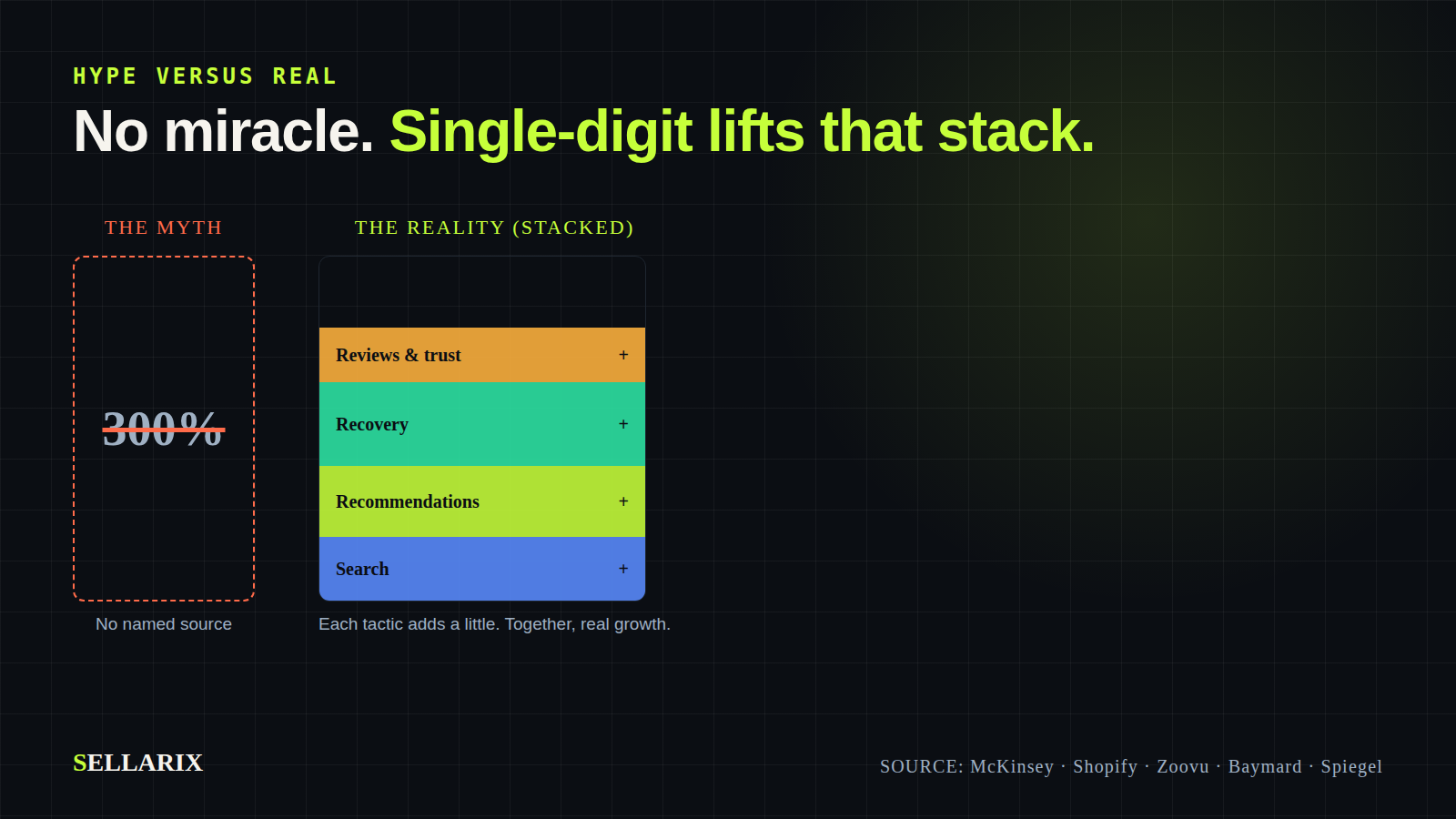
Be sceptical of the screenshots. The "300% revenue", "400% ROI" and "150% conversion" figures floating around come from vendor and aggregator posts, not named studies, so they're not here [6]. What is real and sourced: dynamic pricing around +2-5% sales (McKinsey) [4], personalisation roughly +10-25% conservative [6], AI-assisted shoppers about +25% likelihood to convert (Zoovu) [3], AI-referred shoppers about +50% conversion (Shopify) [2], a +35% checkout-design lift (Baymard) [1], and +270% purchase likelihood from the first five reviews (Spiegel) [8]. The honest model: each tactic adds a single-digit to low-double-digit lift, and the wins stack. Five well-chosen tactics beat one miracle tool, and none of it works without clean product data and enough traffic for the maths to mean anything.
If you only do five things this week
- Fix site search (AI / semantic), search users convert 2-3x [5].
- Switch on real AI recommendations across home, PDP and cart.
- Add a guided-selling quiz or AI chat to answer pre-sale questions.
- Set up AI cart-recovery across email and SMS, that's the 70% [1].
- Rewrite your top 20 PDPs (Benefit + Proof + Spec) and surface reviews.
FAQ
Where do AI conversion gains actually come from? Reducing friction and uncertainty: better discovery, instant answers, accurate visuals, rebuilt carts and credible proof. Each adds a modest lift; the gains stack.
What's the single highest-ROI place to start? For most stores, site search and cart recovery. Search users already convert 2-3x [5], and recovery attacks the 70% that leaks at the end [1].
Do I need a lot of traffic for this? For testing and fine-grained personalisation, yes. With thin traffic, focus on always-on fixes (search, content, recovery, reviews) rather than statistical tests you can't power.
Is dynamic pricing risky for my brand? It can commoditise you if done crudely. Keep firm margin floors and don't penalise loyal customers. McKinsey's 2-5% lift assumes disciplined implementation [4].
Will AI product content hurt my SEO? Only if it's thin and generic. Specific, accurate Benefit + Proof + Spec copy with real specs helps shoppers and AI search alike.
How do I measure whether any of this worked? Track conversion rate by tactic and segment, and test properly (bandit/A-B where traffic allows). Never trust a result you couldn't reproduce.
This is the conversion layer we build at Sellarix: AI for search, recommendations, content, chat and recovery, working together on your store. If you want the plan for yours, the free AI strategy framework is linked below.
Sources
- Baymard Institute, cart abandonment rate (70.22%, ~$260bn, +35.26% checkout lift)
- Shopify, AI-referred shoppers convert ~50% higher
- Zoovu, 2026 Benchmark for AI in Ecommerce Conversion (~+25%)
- McKinsey & Company, dynamic pricing (sales +2-5%, margin +5-10%)
- Algolia, ecommerce search & KPI statistics (site-search users convert ~2-3x)
- Spiegel Research Center, Northwestern University, How Online Reviews Influence Sales (5 reviews, +270%)