AI in Ecommerce 2026: What the Primary Data Says, What's Worth Adopting, and What to Ignore
Shopify reports AI-referred orders up around 13x. Peer-reviewed research puts ChatGPT under 0.2% of ecommerce traffic. Both are true. Here is what to do about it, sourced throughout, including the claims we stopped using.
Two numbers, both from good sources, both published in the last year.
Shopify reported AI-referred orders growing roughly 13 times year on year in Q1 2026, the fastest-growing inbound channel it has tracked[1]. Peer-reviewed work by Kaiser and Schulze in Marketing Science, covering twelve months of first-party data across 973 ecommerce sites and $20 billion of revenue, puts ChatGPT at under 0.2% of ecommerce traffic[2].
Neither is wrong. Thirteen times a very small number is still a small number. Everything sensible you can do about AI in your store this year follows from holding both of those at once.
This piece is the version with the primary sources attached, including a section on the claims we've stopped using because they turned out not to survive checking. Some of them were ours.
The claims we retired, and why
Start here, because half the AI advice aimed at merchants rests on numbers that don't hold up.
| Claim you'll see everywhere | Status |
|---|---|
| "Merchants run 5 to 8 disconnected AI subscriptions" | Unsourced. Repeated across documents until it read as fact. No survey behind it |
| "Over 40% of inventory is ignored by AI shopping assistants" | Unsourced. Traces to an anecdote on a site selling AI-visibility audits. No methodology, sample or date |
| "Returns are exploding" | Refuted. NRF and Appriss data shows returns fell in 2025, in both absolute and percentage terms[3] |
| "$443 billion lost to false declines" | Vendor marketing. A competing vendor publishes $308B for the same claim. 44% apart |
I used two of those in presentations. Nobody checked, including me, because they supported a conclusion I already held. That's how a number becomes a fact.
The replacements are better anyway, and they're all below.
What the good data actually says
AI traffic is small, growing fast, and converts oddly
The Kaiser and Schulze study is the strongest evidence available because it uses first-party data from real stores rather than panel estimates. Under 0.2% of ecommerce traffic from ChatGPT, across 973 sites and $20 billion of revenue over twelve months[2]. Against that, Shopify's own reported ~13x growth in AI-referred orders, and AI-sourced orders bringing new buyers at roughly twice the rate of traditional organic search[1].
Shopify has a commercial interest in AI commerce looking healthy. The study's authors don't. Weight accordingly, and note that both can be right because they're measuring different things at different points on the same curve.
Your product data is the actual problem
Adobe Analytics, working across more than a trillion visits to US retail sites, found product detail pages score worst of any page type for machine readability at around 66%, while FAQ and returns pages score above 80%[4].
SALT.agency audited 141 product pages across 29 retailers and found 70% lacked all three of the attributes the emerging commerce protocols need, 65% had no GTIN, and 15% blocked AI crawlers entirely[5].
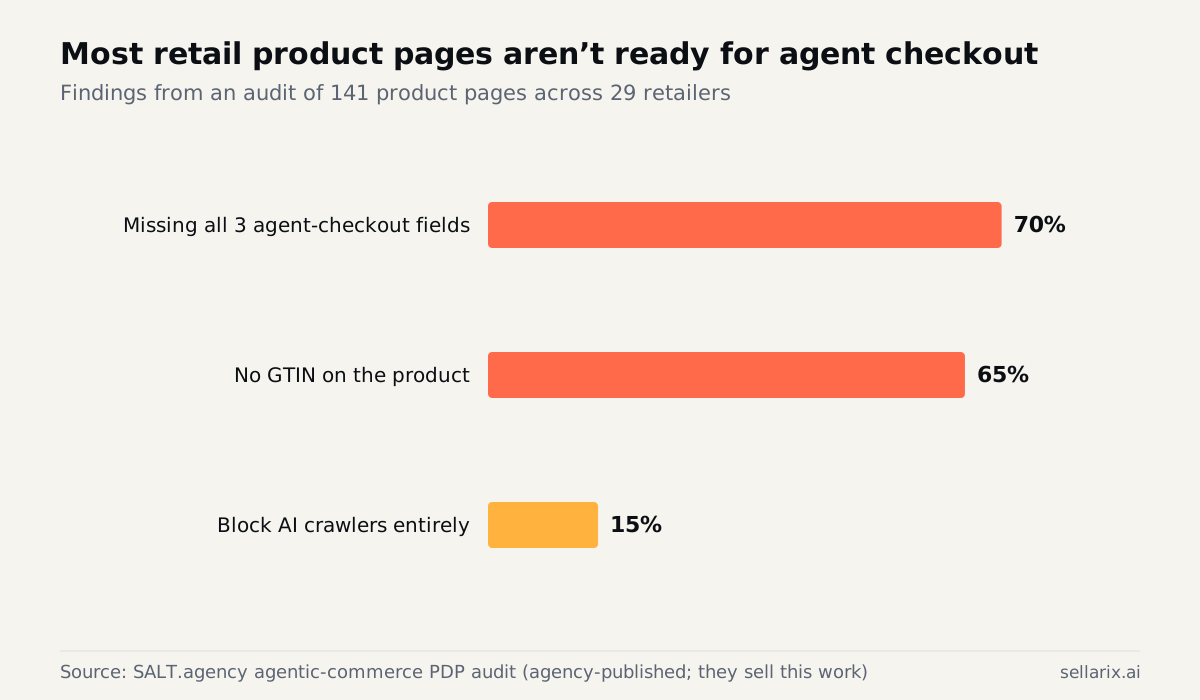
Both are vendor or agency published, which I'll flag rather than hide: Adobe sells commerce software and SALT sells technical SEO. The findings corroborate each other from different methodologies, which is the best available position when no neutral party has measured the thing.
llms.txt is decoration
Ahrefs analysed 137,000 domains and found that 97% of llms.txt files received zero requests in the measurement month. Of the files that did get requests, most traffic came from SEO audit tools and general crawlers rather than AI systems[6]. SE Ranking's earlier analysis across 300,000 domains found no connection between having an llms.txt and AI citation frequency[7].
If somebody sold you an llms.txt as AI visibility work, you bought a text file. Ahrefs sells SEO tooling and had no obvious incentive to publish this, which makes it more credible rather than less.
Adoption is running ahead of measured value
Stanford's AI Index is the best independent annual read on where AI capability and adoption sit, largely because nobody producing it is selling you anything[30]. The pattern it keeps documenting is the one you'll recognise from your own inbox: adoption is climbing much faster than demonstrated business value. That's a reason to be selective, not a reason to be absent.
Does this actually impact you? Sort by what you sell
You'll feel it first if
You sell products people research before buying. Comparison-heavy categories. Anything with specifications, compatibility questions or a "which one do I need" problem. That's where assistants are genuinely useful and where they're being used.
You'll feel it last if
You sell impulse, fashion, gifts or anything bought emotionally from a photo. An assistant is a poor substitute for wanting something.
You should ignore most of this if
You're under about 200 orders a month. Your constraint is demand, not machine readability, and no amount of schema markup fixes that. Go and do the unglamorous work instead. When machine readability does become your constraint, the agentic readiness checklist is the shortest path through it.
What's actually worth adopting, ranked
Ordered by evidence, not by how good the demo looks.
Tier 1: adopt now, evidence is solid
Structured product data. GTINs, valid schema, complete attributes. Helps search, marketplaces, feeds and agents at once, and 65% of audited retailers don't have it[5]. Cheapest high-value work available.
Whatever your platform gives you free. Shopify's Editions releases have absorbed several paid app categories, including merchandising, search and A/B testing[8][9]. Before buying anything AI-branded, check whether it arrived in-plan last quarter.
Fraud tooling, if you have fraud. The MRC's 2026 report, covering 1,278 merchants across 37 countries, found merchants with weak tooling losing 3.9% of revenue to fraud against 0.6% for those with strong tooling, and rejecting 5.2% of good orders against 2.8%[10]. LexisNexis puts the all-in cost at $4.61 for every $1 of fraud in US ecommerce and retail[11]. The fraud prevention piece works through what those numbers mean for a store your size.
The MRC is an industry association rather than a vendor, which makes it the best source in this area. Note the second number as carefully as the first: strong tooling reduces wrongly-rejected good orders too, which is the part fraud vendors under-sell because it's harder to invoice for.
Tier 2: adopt selectively
Support automation. Genuinely works for order status, returns initiation and policy questions. Genuinely doesn't work for anything requiring judgement about an angry customer. The failure mode is a bot confidently giving a wrong answer about a refund, which costs more than the salary it saved.
Content and copy generation. Real time savings on product descriptions and metadata. Watch for two things: generated copy that contradicts your spec sheet, and generated reviews, which are illegal in the US under the FTC rule and prohibited in the UK under the DMCC Act. We covered that in the reviews piece.
Demand forecasting. Works where you have volume and history. Doesn't work on a 200-SKU catalogue with eighteen months of data, whatever the demo shows. If your stock numbers are wrong to begin with, start with the inventory piece.
Tier 3: wait
Fully autonomous agents making commercial decisions. Pricing, purchasing, merchandising without review. The failure modes are expensive and the audit trail is usually absent.
Anything sold on the promise of AI visibility. See the llms.txt data[6]. The category is full of confident claims and thin evidence.
Replatforming for AI reasons. No.
The protocols, explained without the hype
Three specifications matter and they do different jobs.
Model Context Protocol
An open standard for connecting AI models to tools and data sources[12]. Infrastructure. Relevant to you only if you're building something.
Agentic Commerce Protocol
Maintained by OpenAI and Stripe, describing how an agent discovers a product, builds a cart and completes a purchase with a merchant[13][14]. This is the one that touches your checkout.
Universal Commerce Protocol
Google's approach to the same problem, with product, price, availability and fulfilment as structured fields[15].
What they have in common, which is the useful bit
All three need the same thing from you: accurate, current, structured data about what you sell, what it costs, whether you have it, and when it arrives. None of them ask you to adopt an AI product. They ask you to have your data in order.
Which means the correct preparation is identical to the correct preparation for Google Shopping, marketplaces and your own site search. That's a genuinely reassuring conclusion and it's why I'd resist any spend framed as agent-readiness that isn't really data quality work.
If you are on Shopify
Most of it is already there
Shopify ships two Editions a year and has been absorbing paid app categories at a steady rate[8]. Native A/B testing arrived via Rollouts in June 2026[9]. Search and merchandising controls are in-plan[16].
The counterweight
Shopify also removes free tools. Stocky retires on 31 August 2026[17]. Free in-plan is a current state, not a promise, and building a process on a free tool means owning the migration when it goes.
What to actually do
Audit your product data completeness before you buy any AI product, which is really a PIM question. Then check your robots.txt for AI crawler blocks you didn't intend, given 15% of audited retailers had them[5].
Not on Shopify? The other platforms
WooCommerce
The honest position, and it's the one this site exists to argue: deep, action-taking AI tooling on WooCommerce is close to absent. Support vendors that take real commerce actions overwhelmingly support Shopify only, and several market cross-platform support their own documentation contradicts.
What you can do on Woo is entirely data-side, and it works: structured data via a schema plugin or your theme, complete product attributes, a clean feed. The REST API is capable if you're building[18]. Read orders through the API, not the database, since High-Performance Order Storage moved them[19].
Magento and Adobe Commerce
Adobe has the deepest AI stack of any commerce vendor and it is priced and licensed accordingly, frequently requiring a second licence alongside Commerce itself. That is a fragmentation tax inside a supposed all-in-one, and it's worth naming.
What's free and useful: multi-source inventory gives you accurate availability, which is the single most valuable input to any agent-facing surface[20]. Full REST and GraphQL surfaces to build against[21]. Watch the version lifecycle, because every AI integration is a version-bound dependency[22].
BigCommerce
Clean APIs, fewer AI options, and the ones that exist tend to be maintained[23]. Model the GMV thresholds that auto-upgrade your plan[24].
Headless and custom
Best position for structured data and the most responsibility. Server-render your product markup. Headless stores are undercounted in every platform statistic you'll read, because the usual detection fingerprints are gone[25].
The compliance deadline that already passed
Article 50 of the EU AI Act, covering transparency obligations, applies from 2 August 2026[26][27].
For a merchant, the practical scope is narrower than the panic suggests and wider than most stores have handled. If a customer interacts with a chatbot, they need to know it's a machine. AI-generated content shown to consumers needs to be identifiable as such, which now includes AI review summaries and generated product imagery. And if you build the system rather than deploying somebody else's, your obligations are heavier.
Our EU AI Act compliance guide for ecommerce works through what applies to a merchant specifically, rather than reprinting the regulation.
The thing I'd check today: has an AI feature been switched on by a vendor update without anyone deciding to, and is it labelled? That's the most common exposure and it's created by product updates rather than by decisions.
Does consolidation actually help? The evidence is split
Worth including because it's the pitch behind most AI platform buying, including ours, and the honest answer depends entirely on your size.
Below about £1M revenue, the evidence says no. EightX's analysis of over 3.5 million tracked Shopify stores found 83.3% spend nothing at all on apps, and only 1.8% spend over $100 a month[28]. There's very little to consolidate, and free substitutes keep arriving from the platform. It's agency-published data, so treat the precision loosely and the direction as sound.
In the mid-market the evidence says yes. Futurum's survey of 830 IT decision-makers found 41% planning application consolidation, with best-of-breed procurement falling to 20.7%[29].
So the AI consolidation pitch is a mid-market pitch. Aimed at a small store, it's solving a problem the data says that store doesn't have. I'd rather say that plainly than let it sit unexamined.
The readiness checklist
Ten checks. All free. None require buying anything.
| # | Check | Why |
|---|---|---|
| 1 | GTIN present on every sellable product | 65% of audited PDPs lack it[5] |
| 2 | Product schema server-rendered, not injected | Machines that don't run JS see nothing |
| 3 | Price and availability in the markup match the page | Mismatch is a policy violation |
| 4 | robots.txt doesn't block crawlers you want | 15% blocked AI crawlers[5] |
| 5 | Returns and shipping policy on a crawlable page | Policy pages already score well[4] |
| 6 | Stock levels accurate to the hour, not the day | Overselling an agent is worse than overselling a human |
| 7 | Delivery promise is real, not aspirational | Agents compare arrival dates |
| 8 | Review markup valid and visible | Independent signal machines can weigh |
| 9 | Any chatbot is disclosed as AI | EU AI Act Article 50[26] |
| 10 | AI-generated content is labelled | Same obligation, commonly missed[26] |
Nothing on that list is an AI project. Which is the point.
What to do this week
- Check GTIN coverage across your catalogue. One query, and it's the highest-value gap in the list[5].
- View-source a product page. Is the schema there without JavaScript running?[4]
- Read your robots.txt. Out loud, if it helps[5].
- List every AI feature currently live on your store, including ones that arrived in a vendor update. Check each is disclosed[26].
- Delete your llms.txt from the roadmap if it's on there[6].
- Pull your fraud rate and your rejection rate. Compare to 0.6% and 2.8%[10].
- If you're on Shopify and use Stocky, start the migration. 31 August 2026[17].
- Ask any AI vendor for the primary source behind their headline statistic. The answer is informative either way.
The takeaway
AI referral traffic is under 1% of ecommerce and growing very fast[2][1]. Your product pages are the least machine-readable thing you own, at around 66%[4]. Two thirds of retailers have no GTINs[5]. And 97% of llms.txt files are read by nobody[6].
Put those together and the strategy is unexciting. Fix the data. Turn on what your platform already gives you. Buy fraud tooling if you have fraud. Label your bots. Wait on the rest.
The thing I keep having to relearn: the interesting technology and the profitable work are rarely the same week's job. I spent a quarter once on a recommendation engine while the product feed had 400 items with no images in it. The feed would have made more money and I knew it at the time.
What percentage of your catalogue has a GTIN? If you can't answer that in ten minutes, that's this week sorted.
Sources
- Shopify, financial reports, Q1 2026. AI-referred orders up roughly 13x YoY; AI-sourced orders bringing new buyers at ~2x the rate of traditional organic search. Company-reported.
- Maximilian Kaiser and Christian Schulze, "Frontiers: ChatGPT Referrals to E-Commerce Websites", Marketing Science. 973 sites, $20B revenue, 12 months to July 2025. Peer-reviewed, first-party data.
- National Retail Federation and Appriss Retail, "Consumers expected to return nearly $850 billion in merchandise in 2025", 15 October 2025. $849.9B, 15.8% of sales, down from $890B and 16.9%.
- Adobe, "AI traffic surge: retail sites not machine readable". Adobe Analytics, over 1 trillion visits to US retail sites. Vendor-published; Adobe sells commerce software.
- SALT.agency, "Agentic Commerce Protocol PDP analysis". 141 PDPs across 29 retailers. Agency-published; they sell technical SEO.
- Ahrefs, "We analyzed 137K sites: 97% of llms.txt files never get read". Ahrefs sells SEO tooling; the finding cuts against their own category's marketing.
- SE Ranking, llms.txt analysis. 300,000 domains; no connection found between llms.txt and AI citation frequency. Vendor-published.
- Shopify, "Shopify Editions". Accessed 22 July 2026.
- Shopify, "Rollouts now supports online store and checkout and customer accounts", 5 June 2026. Developer changelog.
- Merchant Risk Council, "2026 Global Ecommerce Payments and Fraud Report", 18 March 2026. 1,278 merchants, 37 countries. Industry association, not a vendor.
- LexisNexis Risk Solutions, "True Cost of Fraud, ecommerce and retail", April 2025. n=569. $4.61 per $1 of fraud. Vendor-published; they sell fraud tooling.
- Model Context Protocol, specification and documentation. Accessed 22 July 2026.
- Agentic Commerce Protocol, specification repository. Maintained by OpenAI and Stripe.
- OpenAI, commerce developer documentation. Accessed 22 July 2026.
- Google, "Under the Hood: Universal Commerce Protocol (UCP)". Google Developers Blog.
- Shopify, "Search & Discovery". Free in-plan. Accessed 22 July 2026.
- Shopify, "Transitioning from Stocky". Stocky retires 31 August 2026. Shopify Help Center.
- WooCommerce, "REST API". Accessed 22 July 2026.
- WooCommerce, "High-Performance Order Storage". Accessed 22 July 2026.
- Adobe, "Inventory Management introduction". Accessed 22 July 2026.
- Adobe, "Adobe Commerce REST API". Accessed 22 July 2026.
- Adobe, "Released versions". Accessed 22 July 2026.
- BigCommerce, "Orders API". Accessed 22 July 2026.
- BigCommerce, "Pricing". Accessed 22 July 2026.
- HTTP Archive, "Web Almanac 2025: Ecommerce". Accessed 22 July 2026.
- EU AI Act, Article 50, transparency obligations. Applies from 2 August 2026.
- European Commission, "Regulatory framework for AI". Accessed 22 July 2026.
- Eightx, "Shopify app bloat report 2026". 3,593,277 Storeleads-tracked stores; 83.3% spend £0, 1.8% spend over $100/month. Agency-published.
- The Futurum Group, "41% of firms plan app consolidation". 830 IT decision-makers, 1H 2026.
- Stanford HAI, "2026 AI Index Report". Independent academic index. Accessed 22 July 2026.