Stocky Retires on 31 August 2026: What Actually Replaces It, and What Doesn't
Shopify kills Stocky on 31 August 2026. Shopify's replacement tracks stock but doesn't forecast. Here's the honest replacement decision, priced and cited.
On 31 August 2026 the Stocky app stops working, its API stops responding, and any open purchase order you haven't closed becomes a screenshot[1]. That's about five weeks from now. If you run buying off Stocky, this is the most urgent thing on your list and it probably isn't on your list.
The unhelpful advice doing the rounds is "just move to Shopify's built-in inventory management." That's half right. Shopify's replacement is genuinely better at some things Stocky was bad at. It's also not a demand planning tool, and if you were using Stocky for buying decisions, nobody has replaced that for free.
What Shopify is actually retiring, and what it isn't
Stocky came bundled with Shopify POS Pro, and if you installed it before 4 May 2020 it was free with your subscription. It did purchase orders, supplier records, stocktakes, cost tracking and, once upon a time, demand forecasting.
Shopify stripped the forecasting out in July 2025. The rest goes on 31 August 2026. Shopify's own transition guidance tells you to export historical data before the deadline, close all open purchase orders, migrate your workflows into Shopify admin or POS, and update any third-party integrations that talk to Stocky[1]. If you installed Stocky before 4 May 2020 it came free with your Shopify subscription; otherwise it shipped with POS Pro[15], which is currently £69/month per location on top of your plan[16].
There's a broader point in here that nobody likes saying out loud. Free tooling from a platform is not a commitment. Shopify gave Stocky away for six years and is now taking it back, and the merchants most affected are the ones who built process around it precisely because it was free.
The gaps Shopify's own docs admit
Read the transition page carefully and it lists what doesn't come across. Historical purchase orders cannot be imported; you can only create new ones going forward. Supplier records cannot be exported from Stocky at all. Every Stocky API integration stops on the deadline. Custom fields on transfers become metafields you have to set up manually. Weighted-average costing and dedicated counting workflows may need third-party apps[1].
And forecasting is listed as "partially addressed" through Sidekick suggestions[1]. Partially addressed is doing a lot of work in that sentence. An AI assistant that can answer a question about your stock is not the same thing as a system that tells you how many units to buy for October.
What you're getting instead is real-time inventory synced across locations, transfers, purchase order tracking, bulk adjustments, unlimited inventory history and low-stock alerts through Flow[1]. That's a better tracking system than Stocky was. It is a tracking system.
Does this actually affect you?
Three groups, and only one of them has a real problem.
If you used Stocky only for stocktakes and the occasional purchase order, you're fine. Export your data, learn the new screens, move on. Half a day.
If you used Stocky's purchase order flow as your buying system of record, with supplier records and cost history, you have a data migration problem. Suppliers don't export. Historical POs don't import. You need to get that data out by hand before the deadline, into a spreadsheet at minimum, because after 31 August it's gone.
If you have anything talking to the Stocky API, you have an engineering problem with a hard date. That one's the worst because it fails silently on a Monday morning.
Worth noting that this is not a one-off. Shopify ships a new API version every quarter, supports each stable version for a minimum of twelve months, and guarantees at least nine months of overlap between consecutive versions[12]. The REST Admin API has been marked legacy since October 2024, and every new public app submitted to the App Store since April 2025 has had to use GraphQL[13]. If Stocky's retirement caught you out, that cadence is the thing to plan around, not this one deadline.
The stakes if you do nothing
Inventory errors are not a rounding problem. Appriss Retail's 2026 Total Retail Loss Benchmark puts total retail loss at $796 billion for 2025, of which $90 billion is shrink, and inventory errors alone account for $19 billion of it[2]. That's errors, not theft. Bad counts, bad receipts, bad transfers.
Appriss sells loss prevention analytics, so they have every reason to make that number large. The methodology at least is disclosed: 250 million unique customer identifiers plus a poll of over 1,000 consumers[2]. Treat the direction as solid and the precision as marketing.
The more immediate stake is simpler. Between 1 September and Black Friday there are twelve weeks. If your buying process breaks in week one of September, you're placing Q4 orders on instinct.
What we found: nobody under $500 a month publishes a forecasting method
We went through the pricing and product pages of the main Shopify-tier inventory tools looking for one thing. Not accuracy claims. Method. What model, what inputs, what history it needs, what it does when there isn't enough data.
Here's what we found.
Prediko prices by annual GMV, starting at $49/month under $100k GMV, with unlimited users, SKUs and purchase orders, plus a $20/month raw materials and BOM add-on[3]. The pricing page describes "Revenue & Sales Forecasting" and says nothing about how it works.
Fabrikatör lists SEED at $99/month, SCALE-UP at $149, GROWTH at $199, each with $0.75 per backorder after 50 free, and Enterprise custom above $2.5M revenue. 4.8 stars across 104 reviews. It claims SKU-level demand forecasting from sales history[4]. No method stated.
Inventory Planner (Sage) doesn't publish a price at all any more. The pricing page says only that pricing is "based on the volume of inventory you manage" and routes you to a request form[5].
Lokad is the outlier and it's worth understanding why. They publish essays on their method, they charge from the low thousands per month per decision type, and they'll tell you plainly that a flat monthly fee is set by the complexity of your supply chain rather than a SKU count[6]. Different class of product, different class of price, and completely wrong for a £2M Shopify store.
The uncomfortable conclusion
Under about $500 a month, "AI forecasting" in this category usually means a moving average with seasonality applied from last year, wrapped in a good interface. Which is fine. Moving averages work. The problem is that nobody says so, so you can't tell which tools are doing something more sophisticated and which aren't.
I'd go further and say the honest thing most of these tools should publish is a data requirements table. You need roughly 24 months of history to separate level, trend and seasonality, because you need at least two observations per seasonal period. Under three months you have a moving average and nothing else. Three to twelve months gets you trend and velocity but seasonality is guesswork. Twelve to twenty-four months lets you apply last year's shape without being able to validate it.
No vendor at this price point states that, because it undercuts the sale to a merchant who's been trading for eight months. It's still true.
Your replacement options, honestly
Stay native
Shopify's built-in inventory plus Flow for low-stock alerts, plus a spreadsheet for buying. Cost: £0. Good enough if your assortment is small, your lead times are short, and you reorder on gut plus a stock report.
The failure mode is seasonal. Native tools tell you what you have. They don't tell you what you'll need in fourteen weeks when your supplier's lead time is twelve.
Buy a Shopify-tier planning app
Prediko, Fabrikatör and the rest. $49 to $199 a month for most stores[3][4]. You get purchase order workflow, supplier management, reorder points and a forecast whose method you can't inspect.
Worth it if buying is a weekly job for someone on your team. The purchase order workflow alone usually justifies the price; the forecast is a bonus you should sanity-check against your own numbers for the first two seasons.
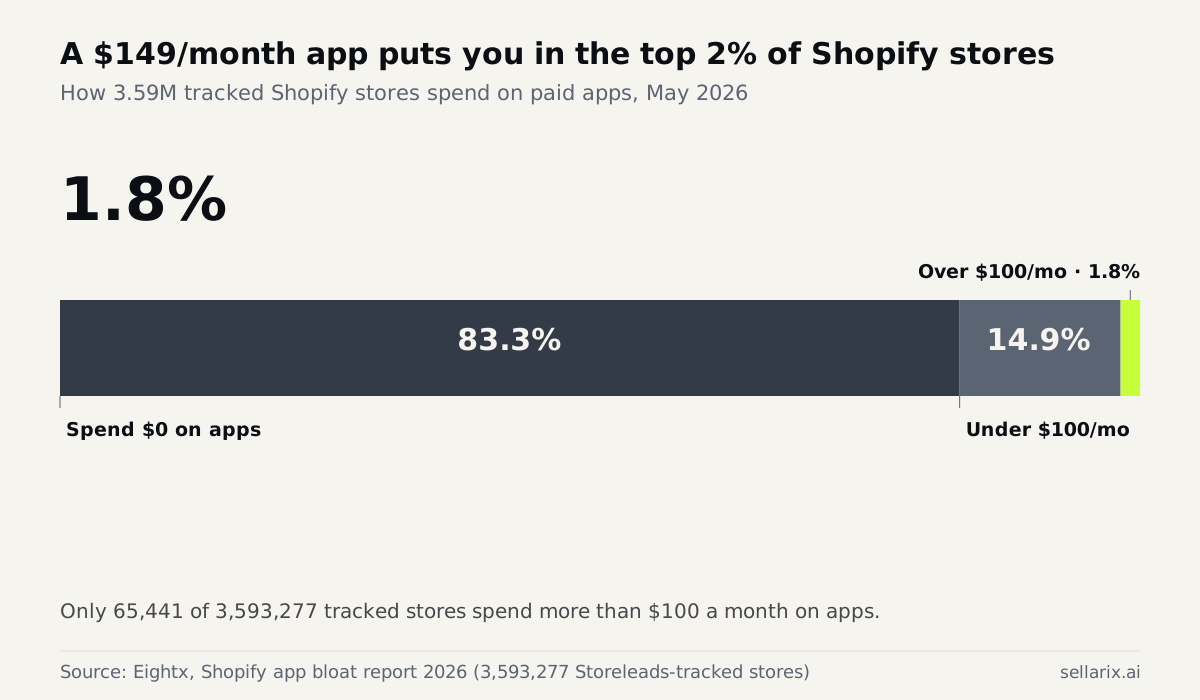
Some context on what that spend means. Of 3,593,277 Storeleads-tracked Shopify stores in May 2026, only 65,441 (1.8%) had detectable app spend above $100 a month, and roughly 2.99 million (83.3%) spend nothing on paid apps at all[14]. Adding a $149/month planning app puts you in the top 2% of Shopify stores by app spend. That's not an argument against doing it. It is an argument for knowing what you're buying.
Go up to a planning platform
Netstock, Streamline, Lokad. These start around $400/month and go to several thousand[6][7]. Most assume an ERP underneath, which is the real barrier. Netstock in particular is an ERP add-on rather than a standalone tool.
Right answer at £15M and up with genuine assortment complexity. Overkill below that.
Build the reorder report yourself
Unfashionable and frequently correct. Weeks of cover per SKU, lead time per supplier, a reorder flag when cover drops below lead time plus a safety buffer. That's four columns and a query. It won't handle seasonality, but neither will a $49/month tool with any confidence.
I ran a business for years on exactly this. Then I bought a forecasting tool, and for the first two seasons its numbers were worse than mine, because it didn't know about the supplier who was always three weeks late. Tools don't know your suppliers. You do.
Not on Shopify? What the other platforms give you
The Stocky deadline is a Shopify event, but the underlying problem is universal, and the platform you're on determines how much you're starting from scratch.
WooCommerce
Core Woo gives you stock quantity, backorder settings, low-stock thresholds and stock status per product or variation[8]. That's it. No purchase orders, no supplier records, no cost of goods, no forecasting.
The upside is that it's a database you own. A weeks-of-cover report on Woo is a SQL query against your product meta and order tables, and you can schedule it. The downside is that nobody's going to write it for you, and the extension market for Woo inventory planning is thin compared to Shopify's.
If you're on Woo and doing real buying, the honest options are an external tool that syncs via the REST API, or an ERP. There's very little in between.
Magento and Adobe Commerce
Adobe's Inventory Management module (formerly MSI) is genuinely good at the thing it does: sources, stocks, aggregated quantities across locations, concurrent checkout protection and shipment matching algorithms. It's pre-installed and enabled by default in both Magento Open Source and Adobe Commerce[9].
What it doesn't do, and Adobe's documentation doesn't claim it does, is demand forecasting or purchase order management[9]. Magento merchants at scale almost always have an ERP doing that, and the Commerce inventory module is the storefront-facing availability layer rather than the planning layer.
The trap on Magento is multi-source setups where the storefront availability and the ERP's view of stock drift apart. Reconcile those weekly, not monthly.
BigCommerce
Native inventory tracking, multi-location, and a decent API. No planning layer. The commercial consideration is that BigCommerce auto-upgrades your plan at GMV boundaries: Core to Growth at $30,000 trailing-twelve-month GMV, Growth to Scale at $100,000, and Scale carries a 0.9% overage above $33,333/month GMV[10]. Worth knowing before you add a paid app on top.
Custom and headless
You have the best possible position and the most work. Inventory is your data in your database, so weeks of cover, sell-through and dead stock classification are all queries you can write once and run forever.
The thing that catches custom builds is oversell under concurrency. Two carts, one unit, no reservation. Adobe solved this with explicit concurrent checkout protection[9]; if you built your own, check you did too. Adobe's inventory REST API is a reasonable model to copy if you're designing the source-and-stock separation from scratch[17].
The five-week Stocky checklist
Lift this. Work down it in order. Everything above the line has a hard deadline of 31 August 2026.
| # | Task | Why it can't wait |
|---|---|---|
| 1 | Export every supplier record by hand | Suppliers cannot be exported from Stocky[1] |
| 2 | Export all historical purchase orders | Historical POs cannot be imported into Shopify[1] |
| 3 | Export stocktakes and unit costs | Cost history is what your margin reporting runs on |
| 4 | List everything calling the Stocky API | All Stocky APIs stop on 31 August[1] |
| 5 | Close every open purchase order | Shopify's transition guidance requires it[1] |
| 6 | Rebuild transfer custom fields as metafields | Manual setup, not automatic[1] |
| 7 | Decide native vs app vs spreadsheet | Before Q4 buying, not during |
| 8 | Set Flow low-stock alerts | Free, and it's the one native early warning you get[1] |
| 9 | Write down lead time per supplier | No tool knows this. It's the input that matters most |
| 10 | Run one manual Q4 buy plan in parallel | So you can check whatever you buy against reality |
The stock you forgot about: returns coming back in
Almost every inventory conversation treats stock as a one-way flow. It isn't, and the numbers are large enough that ignoring them wrecks a plan.
The National Retail Federation, working with Happy Returns, put US returns at $849.9 billion in 2025, which is 15.8% of sales. Online specifically runs higher, at an estimated 19.3% of online sales[18]. Note that returns actually fell that year, from $890 billion and 16.9% in 2024[18]. Plenty of vendor content still says returns are exploding. They aren't, and the primary data says so.
What that means for buying is specific. If one in five online units comes back and most of it is resaleable, then your effective sell-through is not your gross sell-through, and a forecast built on gross orders will systematically over-order. On apparel it's worse than one in five.
Two practical fixes. Forecast on net units, not gross orders. And put a return-to-saleable lag into your available-to-sell calculation, because a unit sitting in a returns bin for eleven days is not stock you can sell, even though your system says it is[19].
How to evaluate a forecasting tool without being lied to
Four questions. Ask them in a demo and watch what happens.
"How many months of history does this need before the seasonal component is meaningful?" If the answer isn't at least 24, they're either applying last year's shape without validation or they're guessing. Both can be fine. Saying so is the test.
"What's your forecast error metric, at what horizon, at what aggregation level?" A claim like "up to 99% accuracy" with no error metric, no horizon and no aggregation level is not a claim. Aggregate forecasts are always more accurate than SKU-level ones, so a vendor quoting company-level accuracy is quoting an easier exam.
"What happens on a SKU with no history?" The honest answer is a similar-SKU analogue, and the follow-up is "how do you match them?" Borrowed history is legitimate. Undocumented borrowed history isn't.
"Does the forecast know about my supplier lead times, or do I add those separately?" A demand forecast with no lead time input can't produce a reorder date. Plenty of tools forecast demand and then quietly leave the hardest part to you.
What agents change about stock, and what they don't
Agentic checkout adds one real constraint here and a lot of noise. The real one: an AI agent transacting on a buyer's behalf needs to know an item is actually available and roughly when it will arrive, before it commits. Google's Universal Commerce Protocol, launched at NRF on 11 January 2026 with Shopify, Etsy, Wayfair, Target and Walmart as co-developers[11], is built around structured availability and delivery data being machine-readable.
Which means stock accuracy stops being an internal ops metric and becomes a discovery signal. An agent that gets burned by your availability data once has no reason to surface you again.
The Agentic Commerce Protocol, maintained by OpenAI and Stripe and currently at spec version 2026-04-17, defines the same shape from the other direction: a cart the agent can query, fulfilment options it can read, and a checkout it can complete[20]. Both specs assume your availability data is true.
The noise is everything else. Nobody's forecasting is about to get materially better because of AI agents. The demand signal is the same demand signal.
What to do this week
- Open Stocky and export everything today. Suppliers by hand, POs, stocktakes, costs. This is the only irreversible item on the list[1].
- Grep your codebase and your integration list for Stocky. Anything hitting that API has 5 weeks.
- Write down lead times per supplier. Actual observed lead times, not the ones on the contract.
- Build a weeks-of-cover report. Units on hand divided by average weekly sales over the last 8 weeks. One column. It'll tell you more than most forecasts.
- Decide before 31 August, not after. Native plus spreadsheet is a legitimate answer. Deciding in September is not.
- If you're buying a tool, ask the four questions above. Score the answers, not the demo.
- Not on Shopify? Do steps 3, 4 and 6 anyway. You've got the same job without the deadline.
The takeaway
Shopify's replacement for Stocky is a better tracking system and not a planning system, and Shopify's own documentation says so in the gaps it lists[1]. If you were using Stocky to decide what to buy, that job is now yours to solve, either with a paid app whose method you can't see or with four columns in a spreadsheet you understand completely.
My stance, and reasonable people disagree: for most stores under £5M, the spreadsheet plus honest lead times beats a $99/month forecast for the first two seasons. Buy the tool when the purchase order workflow is costing you a day a week, not because the word forecasting is on the box.
Five weeks. Have you exported your suppliers yet?
Sources
- Migrating from Stocky to Shopify inventory management. Shopify Help Center. Accessed 22 July 2026.
- The 2026 Total Retail Loss Benchmark Report. Appriss Retail, February 2026. Vendor-published; Appriss sells retail loss prevention analytics.
- Prediko Pricing & Plans. Prediko. Accessed 22 July 2026.
- Fabrikatör Inventory Planner. Shopify App Store listing. Accessed 22 July 2026.
- Inventory Planner Pricing. Inventory Planner by Sage. Accessed 22 July 2026.
- FAQ: Contractual Agreement. Lokad. Accessed 22 July 2026.
- Netstock Pricing. Netstock. Accessed 22 July 2026.
- Managing Products (inventory settings). WooCommerce documentation. Accessed 22 July 2026.
- Inventory Management introduction. Adobe Commerce documentation. Accessed 22 July 2026.
- BigCommerce Pricing. BigCommerce. Accessed 22 July 2026.
- Under the Hood: Universal Commerce Protocol (UCP). Google Developers Blog, January 2026.
- API versioning. Shopify developer documentation. Accessed 22 July 2026.
- Starting April 2025, new public apps must use GraphQL. Shopify developer changelog.
- Shopify app bloat report 2026. Eightx, May 2026. Analysis of 3,593,277 Storeleads-tracked stores.
- Stocky. Shopify Help Center. Accessed 22 July 2026.
- Shopify Pricing (UK). Shopify. Accessed 22 July 2026.
- Inventory REST API. Adobe Commerce developer documentation. Accessed 22 July 2026.
- Consumers Expected to Return Nearly $850 Billion in Merchandise in 2025. National Retail Federation with Happy Returns (a UPS company), 15 October 2025.
- 2025 Retail Returns Landscape. National Retail Federation. Accessed 22 July 2026.
- Agentic Commerce Protocol specification. Maintained by OpenAI and Stripe. Spec version 2026-04-17.