Retail Media for Mid-Market Stores: Do the Maths Before You Build an Ad Network
Amazon and Walmart are taking 89% of the incremental retail media dollar. Instacart, a real network at real scale, monetises at 3% of GMV. Here is what those two numbers mean for a store your size.
Someone will tell you this year that retail media is the highest-margin business in retail and you should build one. They're right about the margin. They're usually wrong about you.
Here's the number that settles most of these conversations, and almost nobody quotes it. Instacart runs a genuine retail media network, at real scale, with thousands of CPG brands buying against it. In Q4 2025 its advertising and other revenue was $294 million, up 10% year on year, which the company put at 3.0% of gross transaction value[1][2].
Three percent. That's the mature, well-run, publicly-reported ceiling. Run your own GMV through it before you read another word.
Two completely different decisions wearing one name
"Should we do retail media" is two questions and people answer the wrong one constantly.
Buying: advertising inside somebody else's network
Sponsored Products on Amazon, Sponsored Search on eBay, ads on TikTok Shop. You're the advertiser. This is a media-buying decision and most mid-market stores should already be doing it where they have marketplace presence. See the marketplaces piece for whether you should be on those channels at all.
Selling: building placements on your own store
Sponsored slots in your own search results, paid category placements, brand-funded homepage takeovers. You're the publisher. This is a product and sales decision, and it's an entirely different business from the one you're currently in.
The margin story people repeat belongs to the second one. The realistic opportunity for almost every reader belongs to the first. Confusing them is how a year disappears.
Does this actually impact you? The publisher test
You can only sell advertising if somebody wants to buy it. That requires four things at once, and missing any one of them ends the conversation.
| Requirement | Why it's non-negotiable | Rough threshold |
|---|---|---|
| Competing sellers | An auction needs at least two bidders per slot | Multiple brands or third-party sellers in the same category |
| Catalogue depth | A sponsored slot must change who wins the sale | Enough SKUs that ranking is a real decision |
| Purchase-intent traffic | Brands buy intent, not impressions | Meaningful, repeatable on-site search volume |
| Closed-loop measurement | You have to prove the ad caused the sale | Attributable order data you can report[3] |
If you're a single-brand DTC store, you fail the first test outright. You are the only possible advertiser. Selling ad space to yourself is called merchandising, it's free, and you should be doing it anyway.
Multi-brand retailers and marketplaces pass the first two easily. The third and fourth are where it usually falls over, and the fourth is the one that kills deals after they've been agreed.
The money is real. It's also going to two companies.
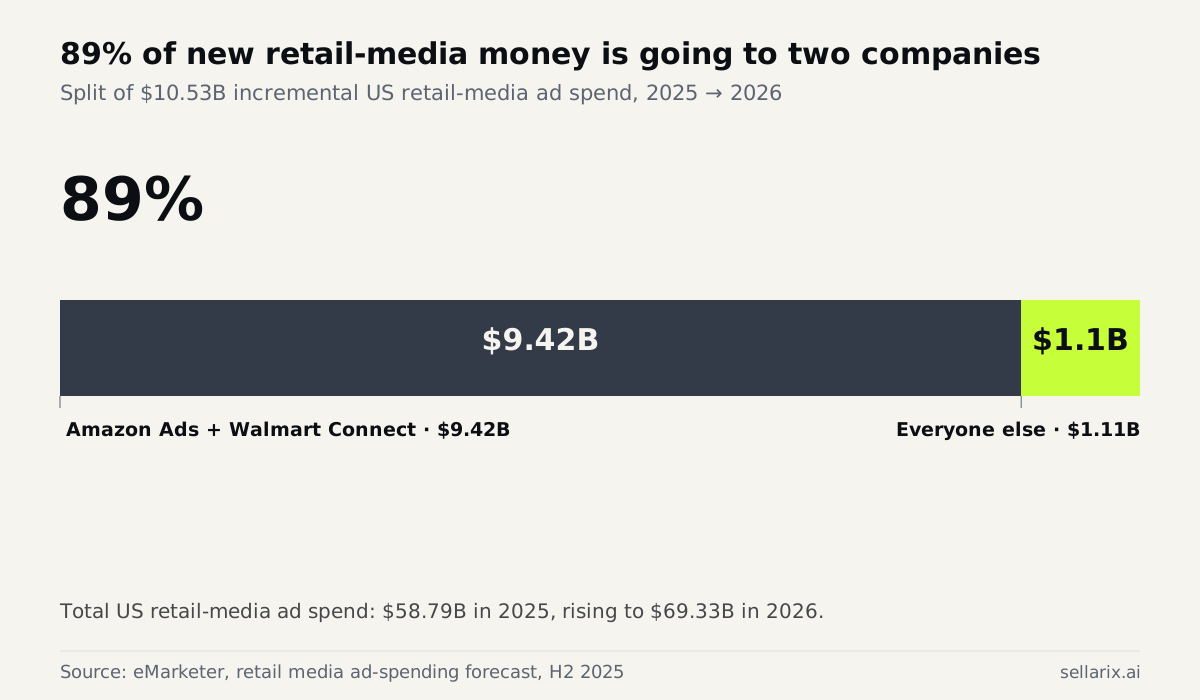
eMarketer's H2 2025 forecast puts US retail media ad spend at $58.79 billion in 2025 rising to $69.33 billion in 2026, which is $10.53 billion of incremental spend[4].
Now the part that matters. Of that $10.53 billion in new money, eMarketer expects $9.42 billion to go to Amazon Ads and Walmart Connect, roughly 89% of every incremental retail media dollar[4].
The company reporting backs that up. Amazon's Q4 2025 results put advertising services revenue at $21.3 billion for the quarter, and the company added over $12 billion of incremental advertising revenue across 2025[5]. Walmart's Q4 FY26 release reports global advertising up 37%, with Walmart Connect in the US up 41%[6].
A category growing fast while two players absorb nine tenths of the growth isn't an open market. It's a consolidating one. That doesn't mean there's no room below them. It does mean the room is smaller and quieter than the headline number suggests, and that the brands with retail media budgets are spending most of it before they get to your line item.
What we found: the honest revenue ceiling is about 3% of GMV
We went looking for a publicly-reported retail media network small enough to be comparable to a mid-market retailer, with actual disclosed numbers rather than vendor projections. Instacart is the closest thing available.
The Instacart benchmark
Q4 2025: advertising and other revenue of $294 million, up 10% year on year, reported as 3.0% of GTV[1][2].
Instacart has everything on the checklist above. Thousands of competing CPG advertisers. Enormous catalogue. High-intent, high-frequency shoppers. A closed measurement loop it built and sells. And it converts all of that into three percent.
Run it against your business
| Your annual GMV | Gross ad revenue at 3% | At a more realistic 1% |
|---|---|---|
| £2M | £60,000 | £20,000 |
| £5M | £150,000 | £50,000 |
| £15M | £450,000 | £150,000 |
| £50M | £1.5M | £500,000 |
| £150M | £4.5M | £1.5M |
Applying Instacart's reported ad-revenue-to-GTV ratio as a best case, and a third of it as a starting case. Illustrative arithmetic, not a forecast.
Now subtract the cost of the people who sell it. A retail media network is a sales team wearing a technology costume. Somebody has to pitch brands, negotiate, build the decks, chase the invoices and produce the reporting. Below roughly £15M GMV the gross ad revenue at 3% doesn't cover one competent ad salesperson and the engineering to support them.
That's the finding. Not "retail media is bad". Retail media has a payroll floor, and the floor is higher than most people modelling it assume.
The 70 to 90% margin claim, and who keeps repeating it
You'll see it everywhere: retail media runs at 70 to 90% margin against the 3 to 4% net margin of selling actual products. The figure traces to Forrester and gets recirculated mostly by consultancies and platform vendors who sell retail media enablement[7][8].
Say plainly what that means. Both of those sources sell into the problem the statistic describes. Mirakl sells marketplace and retail media software. The Retail Exec is a consultancy. Neither is lying, and the gross margin on ad inventory genuinely is very high, because the marginal cost of serving one more impression is close to nothing.
The word doing the work is gross. Gross margin on ad inventory ignores the sales team, the ad operations team, the engineering, the measurement infrastructure and the account management. Those are most of the cost of a retail media network. A business with 85% gross margin and a cost base that scales with revenue is a normal services business, not a money printer.
I'd rather you carried one honest sentence out of this section than the statistic. Retail media has software margins and services costs.
What building it actually involves
People picture a sponsored badge. The badge is about 5% of the work.
The auction
Second-price or first-price, floor prices, budget pacing so a brand's daily spend doesn't evaporate by 9am, and relevance scoring so the highest bidder doesn't surface an irrelevant product and wreck your search results. Auction quality is the difference between an ad product and a way to annoy shoppers.
Placement and rendering
Sponsored slots in search, category pages, product detail pages, cart. Each is a different surface with different rules. Every one of them must be clearly labelled as advertising, which is a legal requirement in most markets rather than a design preference.
Billing and reconciliation
Impressions and clicks counted, invalid traffic filtered, credit terms, invoices, disputes. Brands will query your numbers. You need to be able to answer.
Reporting
Advertisers expect a self-serve dashboard with attributed sales, not a monthly PDF. This is the part that always gets underestimated and it's the part that determines renewals.
The sales motion
None of the above generates a pound until somebody sells it. If you don't have or can't hire a person who has sold media before, stop here.
Platform by platform: what you can actually do today
Shopify
There is no native sponsored-placement product. What you have is Search & Discovery for merchandising rules and boosts, which is free and in-plan[20], plus the Storefront and Admin APIs if you're building something custom[9]. Realistically, a Shopify retail media build is a headless search layer plus your own auction service, and that's a serious engineering project rather than an app install.
If you're a single-brand store on Shopify, use the merchandising controls and stop. That's your version of this, and the site search piece covers how to get the most out of it without paying anyone.
WooCommerce
Plugin territory, and it shows. Woo can host sponsored placements because it's WordPress and WordPress will render anything, but you're assembling an ad server from parts and you own the maintenance. The REST API is stable enough to build against[10]. The risk is that a plugin update changes your placement logic, which is the general Woo pattern rather than anything specific to ads.
Magento and Adobe Commerce
The strongest native starting point of the four, because multi-vendor and B2B setups are normal here and the platform already models complex catalogue rules, per-website scope and a full REST and GraphQL surface[11][12]. If a mid-market retailer is going to build sponsored placements in-house, Adobe is where I'd expect it to be least painful.
BigCommerce
Clean APIs, fewer prebuilt options[13]. Same conclusion as Shopify: buildable, not bought.
Marketplace platforms
If you already run a genuine multi-seller marketplace, you have the auction demand side solved and the build becomes worthwhile much earlier. Everyone else is trying to manufacture bidders.
Measurement is where the deals die
The IAB and MRC published Retail Media Measurement Guidelines in January 2024, covering what counts as an impression, how to attribute a sale and what look-back windows are acceptable[3]. IAB Europe published updated Commerce Media Measurement Standards, with a 30-day look-back window as the reporting default[14]. In November 2025 the IAB added guidelines specifically for incremental measurement in commerce media[15].
That last one exists because the category has a credibility problem, and you should understand it before you sell anything.
The attribution trap
Sponsored placements sit in front of shoppers who were already going to buy. Attribute every subsequent purchase to the ad and you'll report a spectacular ROAS that measures your own existing demand back to the advertiser. Brands' analytics teams have worked this out. The ones with budget now ask for incrementality testing, meaning a genuine holdout, and if you can't run one your reported numbers get discounted.
Which means the experimentation discipline is a prerequisite for the ad business, not a nice-to-have afterwards. If you can't run a clean holdout on your own site, you can't sell measured media.
The disclosure and AI angle
Sponsored placements must be labelled. Beyond that, if you rank or personalise those placements with a model, you're now running automated decision-making in a customer-facing surface, and that carries transparency obligations in the EU that most retail media pitch decks skip entirely. Our EU AI Act compliance guide for ecommerce covers what actually applies and what doesn't.
The side you should probably be on: buying
For most readers, the useful version of retail media is spending, not selling.
The discipline is unglamorous. Know your contribution margin per unit before you set a target ACoS, because an advertising cost of sale that looks fine against revenue can be underwater against margin. Fix product economics before you scale spend, since advertising multiplies whatever unit economics you already have, including bad ones. And treat marketplace ad spend as a cost of the channel rather than a growth lever, because on Amazon in particular, sponsored placement has drifted from optional to structural.
Be careful with ROAS benchmarks generally. Most published ones come from agencies and tools that sell the optimisation, they vary enormously by category and account maturity, and they're not a target you should manage to. Your own contribution margin is.
What agents change about retail media
Genuinely unclear, and I'd distrust anyone confident about it.
Here's the mechanical problem. Retail media is a visual-attention business. Sponsored placements work because a human eye lands on a slot near the top of a page. When an AI assistant does the browsing and returns one recommendation, there is no page, no slot and no attention to sell.
The emerging commerce protocols describe product, price and availability as structured data, and they do not currently describe a paid-placement primitive[16][17]. Either one appears, or agent-mediated demand is unmonetisable ad inventory.
Shopify reported AI-referred orders growing roughly 13 times year on year in Q1 2026, its fastest-growing inbound channel[18]. Fast growth from a small base. Peer-reviewed work by Kaiser and Schulze in Marketing Science, covering 12 months of first-party data across 973 ecommerce sites and $20 billion of revenue, puts ChatGPT at under 0.2% of ecommerce traffic[19]. Both are true and the gap between them is the whole argument.
My honest read: agent traffic is a reason to get your product data right, and not yet a reason to change an advertising plan.
What to do this week
- Multiply your GMV by 3%. That's your optimistic ceiling. Then by 1% for a realistic year one[1].
- Count your potential advertisers. Brands or sellers who compete with each other in your catalogue. Under five, and there's no auction.
- Check your on-site search volume. Searches per session and top queries. That's the inventory you'd be selling.
- Cost the salesperson. Fully loaded. Compare to the 1% number.
- Turn on the free version first. Merchandising rules, boosts and pinned results cost nothing and capture most of the ranking value.
- If you buy marketplace ads, recalculate ACoS against contribution margin, not revenue.
- Read the IAB measurement guidelines before you promise a brand anything about attribution[3].
The takeaway
Retail media is a real, large, fast-growing category in which 89% of the new money goes to two companies[4]. A mature independent network monetises at about 3% of GMV[1]. The famous margin figure is a gross margin published by people who sell the software[7].
Put those together and the mid-market answer is usually: buy media, don't sell it, and revisit at £15M GMV with multiple competing brands in the catalogue.
I've argued the other way before, on a marketplace build where the seller count looked healthy on a slide. It wasn't healthy in the auction. Six sellers isn't a market, it's a queue.
How many brands in your catalogue actually compete with each other for the same search term? Count them. If the answer is under five, you've got your answer.
Sources
- Instacart (Maplebear Inc.), Q4 2025 earnings call transcript, 12 February 2026. Advertising and other revenue $294M, up 10% YoY, 3.0% of GTV.
- CNBC, "Instacart (CART) Q4 2025 earnings", 12 February 2026.
- IAB and MRC, "Retail Media Measurement Guidelines", January 2024. Industry standards body.
- eMarketer, "Retail media ad spending forecast and trends, H2 2025". US retail media $58.79B (2025) to $69.33B (2026); $9.42B of $10.53B incremental to Amazon and Walmart.
- Amazon, Q4 2025 earnings report. Advertising services revenue $21.3B for the quarter.
- Walmart, "Walmart releases Q4 FY26 earnings", 19 February 2026. Global advertising +37%; Walmart Connect US +41%.
- The Retail Exec, "Retail media networks". Cites Forrester 70 to 90% margin. Consultancy; sells into this category.
- Mirakl, "How do retail media networks make money". Vendor; sells marketplace and retail media software.
- Shopify, "Admin GraphQL API". Accessed 22 July 2026.
- WooCommerce, "REST API". Accessed 22 July 2026.
- Adobe, "Adobe Commerce REST API". Accessed 22 July 2026.
- Adobe, "Adobe Commerce GraphQL API". Accessed 22 July 2026.
- BigCommerce, "Orders API". Accessed 22 July 2026.
- IAB Europe, "Updated Commerce (incl. Retail) Media Measurement Standards", January 2026.
- IAB, "Guidelines for Incremental Measurement in Commerce Media", November 2025.
- Google, "Under the Hood: Universal Commerce Protocol (UCP)". Google Developers Blog.
- Agentic Commerce Protocol, specification repository. Maintained by OpenAI and Stripe.
- Shopify, financial reports and Q1 2026 results. AI-referred orders up roughly 13x YoY.
- Maximilian Kaiser and Christian Schulze, "Frontiers: ChatGPT Referrals to E-Commerce Websites: How Do LLMs Compare Against Traditional Channels?", Marketing Science. 973 sites, $20B revenue, 12 months to July 2025. Peer-reviewed.
- Shopify, "Search & Discovery". Free in-plan merchandising, boosts and pinned results. Accessed 22 July 2026.