Avalara vs TaxJar vs the Alternatives: What US Sales Tax Automation Actually Costs in 2026
The honest pricing on Avalara, TaxJar, Stripe Tax and Shopify Tax, plus the free filing route that no tax vendor puts on its homepage. Cited throughout.
A state you have never visited can bill you for tax you never collected, going back years, with penalties and interest stacked on top. You didn't break a rule. The rule moved underneath you, and nobody sent a letter until the assessment arrived.
This piece exists for a specific reason. avalara vs taxjar alternative is the highest-volume search query that reaches this site, and nearly everything ranking for it was written by a third tax vendor hoping you'll switch to them. So here's the version with the actual pricing pages cited, the free option that no tax company puts on its homepage, and an admission of where I got this wrong myself.
What Wayfair actually did, and what it didn't
On 21 June 2018 the Supreme Court decided South Dakota v. Wayfair, Inc. five to four, and overruled both Quill Corp. v. North Dakota (1992) and National Bellas Hess (1967)[1]. Before that, a state could only make you collect sales tax if you had physical presence there. A warehouse. An office. Staff.
After it, economic activity is enough. South Dakota's law, the one the Court blessed, set the bar at more than $100,000 of sales into the state or 200 separate transactions in a year[1]. Almost every state copied that template.
Here's what Wayfair did not do, and this is where most articles go vague. It didn't create a federal rule. It didn't set a national threshold. It didn't give you a grace period. It removed a constitutional protection and handed fifty-odd separate legislatures the pen. What you're dealing with isn't one law. It's a patchwork that keeps moving.
The thresholds have been drifting for three years
The 200-transaction trigger is quietly dying. States worked out that it caught low-value, high-volume sellers who owed almost nothing and cost more to audit than they produced. Alaska dropped it on 1 January 2025. Utah dropped it on 1 July 2025. Illinois dropped it on 1 January 2026[2]. Kentucky drops it on 1 August 2026[3].
That tracking comes from Avalara's own regulatory blog, and Avalara sells the software that handles the complexity it's documenting. Doesn't make it wrong. It's the most current public tracking there is. Just know who's writing it and why.
If you're a seller shipping thousands of £15 orders, this drift is good news. It means fewer accidental registrations. If you sell £400 furniture into fifteen states, it changes nothing at all.
New York is the one that catches everyone
Here's a concrete case worth memorising, because it breaks three assumptions at once. New York's threshold is $500,000 of tangible personal property and more than 100 separate sales, measured over the immediately preceding four sales tax quarters[20].
Three things there. The dollar figure is five times the South Dakota template. The test is AND, not OR, so a high-volume low-value seller can be nowhere near it. And marketplace sales are counted toward the individual seller's threshold[20], even though the marketplace already collected the tax on them.
That last one is the trap. Your platform probably isn't counting them. New York is.
Do you actually have a problem?
Most articles on this topic assume you do, because most are written by people who profit from you deciding yes. Run the check first.
Pull twelve months of orders. Group by ship-to state. Sum the revenue and count the orders. Then compare against each state's threshold. That's it. That's the whole diagnostic, and it's an afternoon in a spreadsheet, not a software purchase.
You almost certainly do not need automation if you're under $100,000 into every state except your home state, your order values are high enough that the transaction count is irrelevant, and you can name every state you're registered in from memory.
You probably do need it if you crossed a threshold in three or more states, you sell through both a marketplace and your own storefront and have to reconcile the two, or you genuinely cannot answer "which states do I owe, and roughly how much" without opening a spreadsheet and thinking hard.
The middle case is the awkward one. One or two states over, no clear trend. Register manually, file quarterly, revisit in six months. Buying a platform for two states is buying a fire suppression system for a candle.
The stakes if you sit on it
Sales tax you failed to collect doesn't vanish. It becomes a liability you personally owe, because you were supposed to collect it from the customer and remit it. You can't retroactively charge a customer from eighteen months ago. So you pay it out of margin, plus penalties, plus interest, and the interest compounds from the date each return was due.
There's no statute of limitations running in your favour either, in most states, if you never registered and never filed. The clock generally starts when a return is filed. No return, no clock. That's the part that turns a £4,000 problem into a £40,000 one.
The other cost is diligence. If you ever sell the business or raise money, uncollected sales tax exposure is one of the first things a buyer's accountants find, and it gets held back from your proceeds at a multiple of the estimated liability. I've watched that conversation happen. It is not fun.
What we found: the published prices don't survive a real order volume
We priced the four main options against a single made-up but realistic profile, using only figures published on the vendors' own pages. One store. 1,200 orders a month. Registered and filing in six states.
Here's what the pricing pages actually say.
TaxJar publishes $39/month for Starter and $99/month for Professional. Both tiers are quoted against a baseline of 200 orders a month. Starter includes 2 AutoFile credits a year with additional filings at $50 each; Professional includes 4 a year at $55 each[4]. So the headline $99 covers roughly one sixth of our profile's order volume and four of the twenty-four returns it needs to file annually. Twenty extra filings at $55 is $1,100 a year before a single order over the tier limit is counted.
Stripe Tax splits into two products. Tax Basic is pay-as-you-go: 0.5% per transaction for the no-code integration, or 40p per transaction via API, in jurisdictions where you're registered, with 10 calculation calls bundled per transaction and 4p per call after that. Tax Complete starts at £70/month and scales past £1,200[5]. At 1,200 orders the API rate lands around £480/month, which is more than the entry Complete tier. That crossover point is not obvious from the page.
Shopify Tax is free on your first $100,000 of global sales each calendar year. After that it's 0.35% per order where tax collection is enabled, 0.25% on Plus, capped at $0.99 per order and $5,000 per calendar year per region[6]. It calculates. It doesn't file.
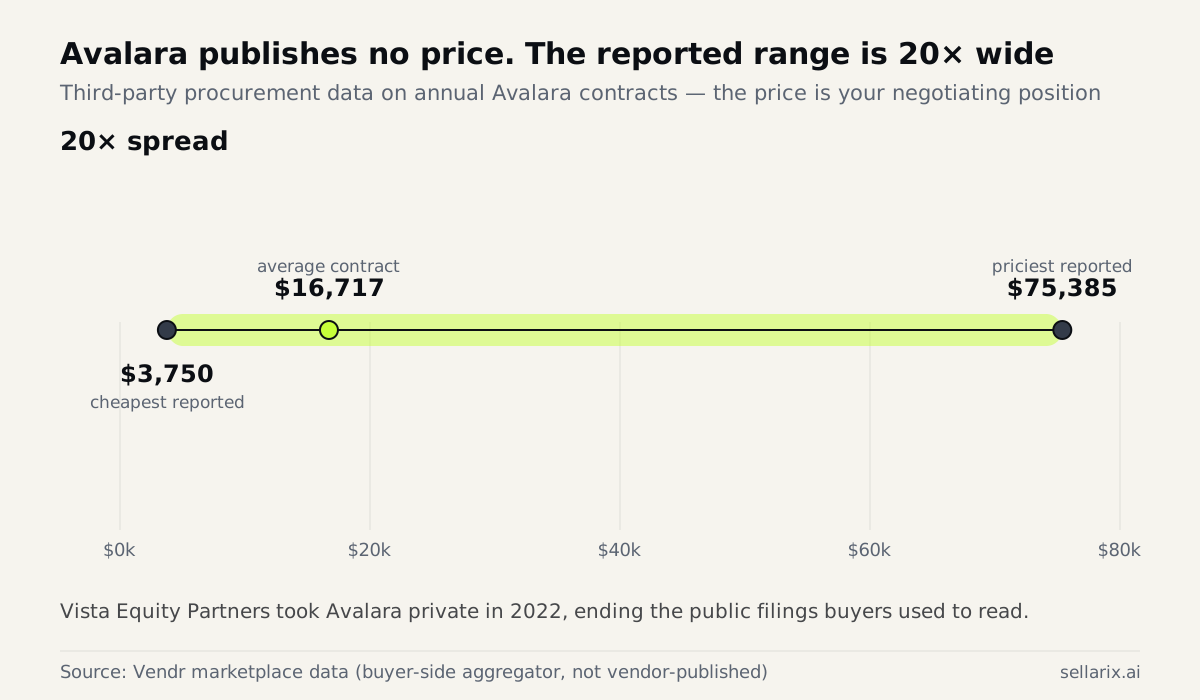
Avalara publishes no price at all. Not a tier, not a range, not a starting-from. Third-party procurement data puts the average contract around $16,717 a year with a spread from roughly $3,750 to $75,385[7]. That's a buyer-side aggregator, not Avalara, and the spread is wide enough that it's a sanity check rather than a quote.
The finding that surprised me
Not one of the four sells the same unit. TaxJar sells orders and filings. Stripe sells transactions and API calls. Shopify sells a percentage of taxable GMV. Avalara sells "transactions" whose definition is set in your contract, and line items, address validation calls and failed API calls can each count separately.
You cannot compare these on price. There is no shared denominator. Anyone publishing a tidy "Avalara vs TaxJar" cost table has invented one, and the invented assumptions are doing all the work.
What you can compare is where the cost goes non-linear. TaxJar goes non-linear on filings. Stripe goes non-linear on transaction count. Shopify caps out and stays capped. Avalara goes non-linear at renewal, which is the one you can't model.
The thing nobody selling tax software leads with
Twenty-four states run the Streamlined Sales and Use Tax Agreement. Under it, member states pay a Certified Service Provider to do your sales tax work, and the CSP is contractually barred from charging you for it in those states[8].
Free. Calculation, return preparation, filing, remittance and audit support, paid for by the states, in the states that participate[9].
You qualify as a "CSP-compensated seller" in a member state if, in the twelve months before registering, you had no fixed location there for more than 30 days, under $50,000 of property there, under $50,000 of payroll there, and under 25% of your total property or payroll there[8]. A remote seller who only registered because of an economic nexus threshold qualifies almost by definition.
The current CSP list includes Avalara, TaxCloud, Sovos, AccurateTax and Avior[8]. Avalara is on it. Avalara will happily sell you a paid contract instead. Both facts are true simultaneously and you have to be the one who raises SST in the sales call, because they are not going to.
I ran a store for two years paying for filings in states where I'd have qualified for free CSP service. Nobody mentioned it. I didn't ask. That one is on me, and it's the single most expensive thing I didn't know about US sales tax.
Where SST stops helping
It only covers member states. California, Texas, New York, Florida, Pennsylvania, Virginia, Colorado, Arizona and Louisiana are not members. If your exposure sits mostly in those, SST solves a slice and you still need a plan for the rest. Registration through the Streamlined system covers all member states in one application[10], which is worth doing on its own merits even if you keep a paid provider for the non-member states.
The vendors, priced honestly
Avalara
The most complete coverage and the least transparent commercial relationship in the category. AvaTax handles the calculation, Returns handles the filing, and the two are separately licensed. There is no published price, which means the price is whatever your negotiating position supports. Vista Equity Partners took Avalara private in a deal announced at $8.4 billion in August 2022[19], which ended the quarterly filings that used to give buyers a read on their unit economics. You are now negotiating with a private-equity-owned vendor whose gross margin you cannot see.
Genuinely worth it if you're filing in fifteen-plus states, selling into multiple countries, or you have product taxability complexity like food, apparel, digital goods or SaaS. Not worth it below that. Ask for the transaction definition in writing before you sign, and ask specifically whether address validation and failed calls count.
TaxJar
Acquired by Stripe in 2021 and now positioned somewhere between a standalone product and a Stripe feature. The published tiers are real, and the AutoFile credit model is the thing that catches people. Four included filings a year against a business that files monthly in six states is 4 of 72.
Good fit: Shopify or Amazon seller, five to ten states, order volume that fits the tier without constant flex fees. Bad fit: anyone who files monthly in more than a handful of states.
Stripe Tax
The cleanest fit if Stripe already processes your payments, because the transaction data is already there and the integration is close to nothing. Tax Basic's no-code 0.5% is expensive at scale but genuinely zero-effort. Tax Complete adds registration and filing in 90+ countries[5], which matters more than it sounds if you sell to the EU and UK as well as the US.
The catch: it's tied to your payment flow. If you take payment through multiple processors, or you have offline or wholesale revenue, you're back to reconciling.
Shopify Tax
Underrated, and specifically underrated by everyone who sells tax software. Free to $100,000 of global sales, then capped at $0.99 an order and $5,000 a year per region[6]. That cap is the important number. A store doing $8M through Shopify pays the same $5,000 as one doing $3M.
It calculates rates and tracks your liability against thresholds. It does not file returns. Pair it with a CSP for filing and you have a legitimate stack for well under what a single Avalara contract costs.
TaxCloud and the other CSPs
TaxCloud is certified in all member states[11]. Sovos and Avior are on the same list. For a remote seller whose exposure is concentrated in member states, a CSP is the answer and the answer is free. This is the option the comparison posts skip, and it is skipped because there's no affiliate commission on free.
Doing it manually
Still correct for a lot of stores. The US has thousands of local taxing jurisdictions and a population-weighted average combined rate of 7.53%, with Louisiana top at 10.13%[12]. That complexity is real, but you only inherit it in states where you're registered. Two states, two returns, forty minutes a quarter. Fine.
Your platform decides more than your vendor does
This is the part almost every comparison article skips, and it's the part that determines whether the implementation takes a day or a quarter.
Shopify
The easiest case by a distance. Shopify Tax is native, and Shopify publishes a liability view against each state's threshold. Read the fine print though: Shopify's own reference is explicit that the merchant is responsible for monitoring, and that marketplace sales are typically excluded from the totals Shopify counts toward a threshold[17]. That exclusion is correct for some states and wrong for others, which is exactly the double-counting trap below.
Avalara and TaxJar both have first-party apps, so the decision here is genuinely just about filing. Calculation is solved. One caveat worth knowing: the $5,000 annual cap is per region, and the regions are US, EU and UK[6]. Sell into all three and it's $15,000, not $5,000.
WooCommerce
The gap here is bigger than most Woo merchants realise. WooCommerce Tax handles automated rate calculation for the US, Canada, Australia, the UK and the EU. It defaults your nexus to your store address, and adding other jurisdictions is a manual configuration step. It does not file returns and it does not track nexus thresholds. The documentation is explicit that it covers how to set up rates, "not when or what to charge"[13].
So on Woo, the calculation problem is solved cheaply and the monitoring problem is not solved at all. You have no built-in equivalent of Shopify's threshold alert. That's the real reason Woo merchants get caught: nothing tells them they crossed a line. Avalara and TaxJar both ship Woo plugins; the CSP route works here too and is cheaper.
Practical fix if you're on Woo and not ready to buy anything: a monthly scheduled report grouping completed orders by billing state with revenue and order count. Twenty lines of SQL. It won't file anything, but it will stop you finding out from an assessment letter.
Magento and Adobe Commerce
Native tax rules are rate-table based and were designed for a pre-Wayfair world where you configured a handful of rates by zone. They still work, and for a small number of states they're fine. At national scale they aren't, because maintaining thousands of local rates by hand is not a job anyone should have.
Both Avalara and Vertex ship supported Adobe Commerce extensions, and this is the platform where the enterprise vendors genuinely earn their price, because the merchants are usually complex enough to need product taxability rules rather than just rates. If you're on Adobe Commerce and running a B2B mix with exemption certificates, that's the case where Avalara's exemption certificate management is the actual product you're buying and the calculation is incidental.
BigCommerce
Sits in between. Automatic tax is available natively and there are supported integrations with Avalara and TaxJar. The commercial wrinkle is BigCommerce's own pricing: Core is $29/month annually with an auto-upgrade at $30,000 trailing-twelve-month GMV, Growth $79 with an upgrade at $100,000, Scale $299 with a 0.9% overage above $33,333/month GMV[14]. If you're near a plan boundary, adding a tax vendor is not the only cost that's about to move.
Custom and headless builds
You own the whole problem. Calculation has to happen at cart, at checkout, at order edit, on refunds and on exchanges, and the four have a habit of disagreeing. The specific failure I've seen most often: partial refunds that refund the full line tax, which quietly overpays the state and understates your margin. Test refunds before you test anything else.
Every major provider has a decent API here, so the vendor choice matters less than the discipline of having exactly one place in the codebase that computes tax.
The decision table
Lift this. It's the whole article in one grid.
| Your situation | Best option | Rough annual cost | Why |
|---|---|---|---|
| One or two states, low volume | Do it manually | £0 plus your time | Automation costs more than the risk |
| Remote seller, exposure mostly in SST member states | A CSP via Streamlined registration | £0 in member states | The states pay the provider, not you[8] |
| On Shopify, under $100k global sales | Shopify Tax | £0 | Free below the threshold[6] |
| On Shopify, above $100k, needs filing | Shopify Tax + a CSP | Capped at $5,000/region | Calculation capped, filing free where eligible |
| Stripe is already your processor | Stripe Tax | 0.5% or 40p/txn, or £70+/mo | Zero integration work[5] |
| 5–10 states, moderate volume, few filings | TaxJar | ~$1,200–3,000 | Watch the AutoFile credit count[4] |
| 15+ states, international, exemption certificates | Avalara or Vertex | ~$16,700 average, wide spread | Only tier where the complexity is real[7] |
| On WooCommerce, any size | WooCommerce Tax + your own threshold report | Low | No native nexus monitoring[13] |
The registration trap that costs more than the software
Registering in a state is not free and it's not reversible without effort. Once you're registered you must file, every period, forever, including zero returns for months where you sold nothing there. Miss one and most states charge a late-filing penalty on a return that owed nothing.
So the sequence matters. Confirm the threshold is genuinely crossed. Check whether the state has a voluntary disclosure agreement that limits your lookback if you're already late. Register. Then turn on collection. Doing it in the other order, turning on collection before registering, means you're holding tax money you have no authority to collect, which is its own problem in several states.
And if you've already got historic exposure, talk to a state and local tax accountant before you register anywhere. Registering fresh in a state you owed back tax in is how you announce yourself. A voluntary disclosure agreement usually caps the lookback and waives penalties. Registering without one doesn't. The Multistate Tax Commission runs a Multistate Voluntary Disclosure Program that lets you approach several states through one application rather than negotiating each separately[18], which is the single least-known useful thing in US sales tax after the SST free-service rule.
Marketplace facilitator laws, and the number everyone double-counts
Every state with a sales tax now has marketplace facilitator rules, which put the collection obligation on Amazon, eBay, Etsy or Walmart rather than on you, for sales made through them.
The mistake is what you do with that revenue when you're counting toward a threshold. Some states include marketplace sales in your economic nexus calculation, some exclude them, and a few include them for the threshold test but not for what you remit. Get this wrong in the inclusive direction and you register somewhere you didn't need to, then file zero returns forever. Get it wrong the other way and you're under-registered.
Worth knowing that your platform has already made a choice for you here. Shopify's US tax reference states that marketplace sales are typically excluded from the sales it counts toward a threshold[17]. That's a sensible default and it is not universally correct. Check it against the states you're near.
This is genuinely the most common error I see, and it's the one thing that does argue for buying software, because a good tool tracks marketplace and direct revenue separately per state and applies each state's rule. A spreadsheet usually doesn't.
What breaks when an AI agent buys from you
Agentic checkout is now a real path to your store rather than a slide. Google's Universal Commerce Protocol launched at NRF on 11 January 2026 with Shopify, Etsy, Wayfair, Target and Walmart as co-developers[15], and the Agentic Commerce Protocol maintained by OpenAI and Stripe is at spec version 2026-04-17[16].
Tax is where these get awkward, and nobody's written about it much yet. An agent needs a total before it commits, and the total includes tax, which depends on a ship-to address the agent may not have collected yet. If your checkout can't return a tax-inclusive total early in the flow, an agent either guesses or abandons.
The practical implication is unglamorous. Your tax calculation needs to be callable as an API against a partial address, quickly, and it needs to return something defensible from a ZIP-level estimate. Most stack configurations can do this. Most haven't tested it. Worth ten minutes with your provider's docs before it matters.
What to do this week
- Run the exposure report. Twelve months of orders, grouped by ship-to state, with revenue and order count. One afternoon.
- Mark the states you're within 20% of. Those are the ones to watch, not the ones you've already crossed.
- Check which of your exposure states are SST members. If most of them are, you may be looking at a free solution rather than a purchase[8].
- Separate marketplace revenue from direct. Two columns. Check each state's rule on whether marketplace sales count toward your threshold.
- If you're already late somewhere, call a SALT accountant before you register. Voluntary disclosure first, registration second. This order saves real money.
- If you're on Woo, build the threshold report. Nothing on that platform will warn you[13].
- If you're buying, get the unit definition in writing. Ask what counts as a transaction, whether failed API calls count, and what the renewal uplift cap is.
The takeaway
The honest version of "Avalara vs TaxJar" is that for a large share of the people searching it, the answer is neither. If your exposure sits in Streamlined member states and you registered because of economic nexus, a Certified Service Provider does the work and the states pay for it[8]. If you're on Shopify under $100,000, it's already free[6]. Avalara earns its price at fifteen states and up, with product taxability complexity and exemption certificates in the mix. Below that it's an expensive way to buy calm.
I'd argue the whole category is mispriced for the mid-market, and that the tax vendors know exactly how many of their customers would qualify for free CSP service. Nobody's going to prove that from the outside.
Go and run the state report. What does it say?
Sources
- South Dakota v. Wayfair, Inc., 585 U.S. ___ (2018). Cornell Legal Information Institute. Decided 21 June 2018. Accessed 22 July 2026.
- Illinois Will Eliminate 200-Transaction Threshold for Economic Nexus. Sovos regulatory update. Accessed 22 July 2026. Vendor-published regulatory tracking.
- Kentucky removes economic nexus transaction threshold. Avalara, April 2026. Vendor-published; Avalara sells the software that manages this complexity.
- TaxJar Pricing. TaxJar (Stripe). Accessed 22 July 2026.
- Stripe Tax Pricing. Stripe. Accessed 22 July 2026.
- Shopify Tax. Shopify. Accessed 22 July 2026.
- Avalara Software Pricing & Plans. Vendr marketplace data. Accessed 22 July 2026. Buyer-side aggregator, not vendor-published.
- Free Services from Certified Service Providers. Streamlined Sales Tax Governing Board. Accessed 22 July 2026.
- What is a CSP. Streamlined Sales Tax Governing Board. Accessed 22 July 2026.
- Streamlined Sales Tax Registration System (SSTRS). Streamlined Sales Tax Governing Board. Accessed 22 July 2026.
- TaxCloud: Certified Service Provider listing. Streamlined Sales Tax Governing Board. Accessed 22 July 2026.
- State and Local Sales Tax Rates, Midyear 2026. Tax Foundation, 6 July 2026.
- WooCommerce Tax documentation. Woo. Accessed 22 July 2026.
- BigCommerce Pricing. BigCommerce. Accessed 22 July 2026.
- Under the Hood: Universal Commerce Protocol (UCP). Google Developers Blog, January 2026.
- Agentic Commerce Protocol specification. Maintained by OpenAI and Stripe. Spec version 2026-04-17. Accessed 22 July 2026.
- US taxes reference. Shopify Help Center. Accessed 22 July 2026.
- Multistate Voluntary Disclosure Program. Multistate Tax Commission. Accessed 22 July 2026.
- Avalara to be Acquired by Vista Equity Partners for $8.4 Billion. Avalara investor relations, August 2022.
- New York Releases Guidance on Economic Nexus Threshold and Requirements for Remote Sellers. Sales Tax Institute. Accessed 22 July 2026.