The Checkout Fixes That Actually Cut Cart Abandonment
Baymard's primary data on why shoppers abandon, what the 70% figure really measures, and the specific fixes on Shopify, Woo, Magento and BigCommerce.
Roughly seven in ten carts never become orders. That figure gets quoted at you constantly, usually by somebody selling an abandoned-cart email tool. What almost nobody tells you is that most of those seven aren't recoverable, and the ones that are get lost for reasons you can fix in an afternoon.
Baymard Institute has been tracking this since 2006. Their running average across 50 separate studies is 70.22%, with the most recent study in the set landing at 71.72%[1]. That's the number on every slide deck. It's also the least useful number in the whole field, and I'll explain why in a second.
The useful data is underneath it. Baymard asked US shoppers who'd abandoned a cart in the past quarter why they did it, and the answers split into a group you can't do anything about and a group that is almost entirely a design and pricing problem. This piece works through the second group, then goes platform by platform: Shopify, WooCommerce, Adobe Commerce, BigCommerce. Every claim links to its primary source, and where a statistic comes from a vendor that sells the fix, I say so.
What the 70% number actually measures, and what it doesn't
Here's the part that gets skipped. When Baymard asked shoppers directly, 42% said they were just browsing and not ready to buy[1]. Adding to cart is how people bookmark things. It's a wishlist with a better button.
So a large slice of your abandonment isn't abandonment at all. It's browsing behaviour recorded by a system that treats every cart as an intent to purchase. Chasing that slice with discount emails trains your best customers to wait for a discount.
Strip the browsers out and what's left is the real list. These are the reasons people who wanted to buy didn't[1]:
| Reason given | Share of abandoners | Is it a design problem? |
|---|---|---|
| Extra costs too high (shipping, tax, fees) | 40% | Partly. Mostly a disclosure problem |
| Delivery was too slow | 20% | No. Operations |
| Didn't trust the site with card details | 19% | Yes |
| Site wanted me to create an account | 18% | Yes. Entirely |
| Checkout too long or complicated | 17% | Yes. Entirely |
| Website had errors or crashed | 17% | Yes |
| Returns policy wasn't satisfactory | 13% | Partly |
| Couldn't see total cost up front | 12% | Yes. Entirely |
| Card was declined | 10% | Partly. Payments config |
| Not enough payment methods | 9% | Yes |
Baymard's wider write-up of the current state of checkout UX is worth reading alongside this[20].
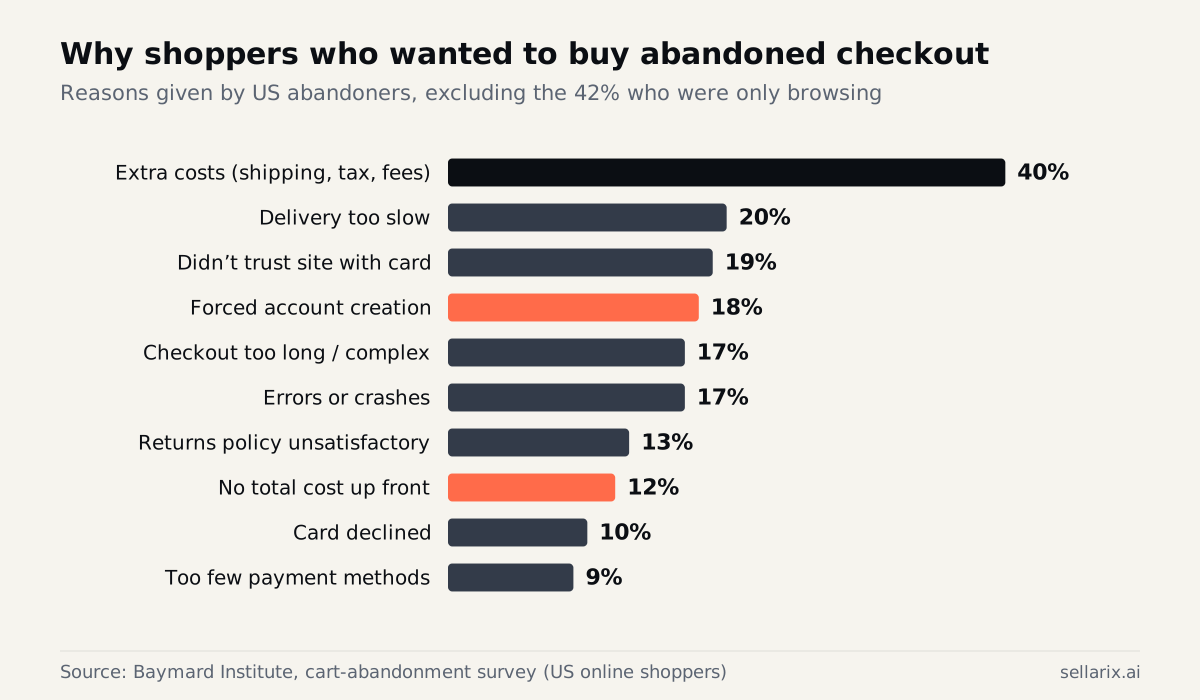
Look at the "entirely" rows. Forced accounts, checkout length, hidden totals. Between them that's a large chunk of lost revenue sitting behind settings you already own.
Does this actually impact you?
Baymard benchmarked 334 top-grossing US and EU sites against more than 110 cart and checkout guidelines. Their finding: 65% of those sites perform at "mediocre" or worse, and the average large site has 32 distinct checkout improvements available to it[2].
These are the top-grossing sites. The ones with dedicated CRO teams. If two thirds of them are mediocre, the prior for your store is not good.
One caveat I'll flag because nobody else does. Baymard sells checkout UX research and audits. Their headline claim is that the average large-scale ecommerce site could raise conversion by 35% through checkout design alone[2]. That is a modelled number from a company whose product is checkout design. Treat the 35% as directional. Treat the survey data underneath it, which is straightforward self-report from 20,000-plus participants across twelve quantitative studies, as solid[2].
The stakes if you do nothing
Do the arithmetic on your own store rather than on an industry average. Take last month's sessions that reached the cart, subtract the orders, multiply the gap by your average order value, then apply the 58% figure (everyone except the browsers) as your addressable share. That's your ceiling, not your target.
The reason to bother is that checkout fixes compound with everything else you spend on. Paid acquisition, email, site search, all of it dumps traffic into the same funnel. A broken checkout taxes every channel simultaneously. It's the one place where a single afternoon's work multiplies across your entire marketing spend, which is why I'd do it before another round of ad creative.
What we found reading four platforms' own checkout docs
We went through the current public documentation for Shopify, WooCommerce, Adobe Commerce and BigCommerce, looking for one thing: what does the platform do by default, before anybody touches it, on the three failure modes Baymard says are entirely design problems.
The pattern that came out is uncomfortable. The platforms have mostly fixed the defaults. The damage is done by merchants and apps changing them.
- Guest checkout ships enabled or available on all four. Adobe exposes it as an explicit "Allow Guest Checkout" toggle in the sales checkout configuration[3]. WooCommerce exposes it in the accounts and privacy settings[4]. Somebody has to actively switch it off to create the 18% problem.
- Field count is where the platforms lose control, because every upsell app, gift-message field and "how did you hear about us" dropdown adds one. Baymard's benchmark: the average checkout carried 11.3 form fields in 2024, down from 11.8 in 2021 and 12.7 in 2019, against a recommended 8[5]. Three years of progress and the average is still 40% over the recommendation.
- Cost disclosure is a merchant decision on all four platforms. None of them force you to show shipping before the final step. All of them let you.
The honest conclusion from that read-through: this is not a platform problem. It's an accumulation problem. Checkouts get worse one small addition at a time, and nobody ever schedules the removal.
Extra costs, and the only fix that works
40% is the biggest single number on the list[1]. It's also the one most people misread. They see "extra costs too high" and conclude they need free shipping.
Read the next line down. 12% abandoned because they couldn't see or calculate the total up front[1]. Those two findings sit next to each other for a reason. The problem isn't always the amount. It's the reveal.
A £6.95 delivery charge shown on the product page is a fact the shopper prices in before they get emotionally invested. The same £6.95 appearing at step three of four, after they've typed their address, reads as a con. Same money. Completely different reaction.
So the fix, in order of how much it costs you:
- Show a delivery estimate on the product page. Free. Do it today.
- Show the full total, including tax and delivery, in the cart before checkout starts.
- If you have a free-shipping threshold, show the gap to it in the cart. Not a banner. In the cart.
- Only then consider actually absorbing the shipping cost.
I've watched people skip the first three and go straight to the fourth, then wonder why margin fell and conversion didn't move.
Guest checkout, and the account-creation argument you will lose
18% of abandoners named forced account creation[1]. Nearly one in five.
Someone on your team will argue for it anyway, because accounts improve lifetime value metrics and make the CRM tidier. Here's the counter. A guest order still captures the email address. You still get the customer record. What you don't get is a password the shopper will never use again and a reset flow they'll trigger at 11pm on a Sunday.
The version that works: guest checkout by default, with an optional "save these details for next time" checkbox on the confirmation page, after the money has moved. You get most of the accounts and none of the abandonment. Shopify's customer accounts model has moved this way with one-time codes instead of passwords, which is the right direction.
Stance, and you can argue with it: mandatory account creation is the single most indefensible thing still shipping in ecommerce checkouts. There is no version of the business case that survives a 18% abandonment figure.
If you are on Shopify
What Shopify already does for you
Shopify's checkout is not editable in the way it used to be, and that's mostly good news. The old checkout.liquid route is gone and customisation now happens through checkout UI extensions, which run in a sandbox and can't break the page[6]. Shop Pay handles returning-customer autofill. The field count is tight by default.
Where Shopify stores still lose orders
Three places, in order of frequency.
Apps stacking fields. Every checkout extension you install adds surface. Audit them. If an app adds a field and you can't name the report it feeds, remove the app.
Shipping rates configured badly. Carrier-calculated rates that only resolve at the shipping step are the classic hidden-cost trap. Put an estimate on the product page.
Tracking migration debt. If your analytics still depends on scripts that used to live in checkout, they stopped firing. The Web Pixels API is the supported route now, and it runs sandboxed with a defined set of standard events[7]. Plenty of stores are optimising a checkout they can no longer measure. Check yours before you change anything. More on that in the analytics stack piece.
Not on Shopify? The other platforms
WooCommerce
Woo gives you the most control and therefore the most rope. The cart and checkout blocks are now the default experience and they're a genuine improvement on the old shortcode checkout, with a proper block-based extension model for adding fields deliberately rather than by plugin side effect[8].
Two Woo-specific things worth an hour. First, guest checkout lives in the accounts and privacy settings and gets switched off more often than you'd think, usually by a membership plugin[4]. Check it. Second, if you're on a big catalogue and haven't moved to High-Performance Order Storage, checkout writes are still hitting the WordPress posts table, which is where the "site had errors" 17% comes from on busy days[9].
Magento and Adobe Commerce
Adobe's checkout configuration is explicit and well documented. Guest checkout, terms and conditions, cart display, all in one settings page[3]. The problem on Magento is rarely configuration. It's version drift.
Adobe runs a published lifecycle: bug-fix maintenance, then security-only maintenance, then nothing[10]. Support for the 2.4.6 line ends 11 August 2026. 2.4.7 runs to April 2027, 2.4.8 to April 2028, and 2.4.9 went GA in May 2026[11]. A checkout on an unpatched Magento is a security problem before it's a conversion problem. Fix the version, then fix the funnel. There's more on this in the replatforming piece.
BigCommerce
BigCommerce's Optimized One-Page Checkout is decent out of the box and the Checkouts API gives you programmatic control over the whole object if you need it[12]. The thing to watch here is commercial rather than technical: BigCommerce charges a percentage of GMV if you use an "open" payment provider rather than one of its embedded ones, running from 2.0% on Core down to 0.6% on Scale[13]. That fee shapes which payment methods you offer, and payment method availability is 9% of abandonment[1]. Worth modelling before you pick a gateway.
Headless and custom builds
You own everything, which means you own the field count, the error states and the accessibility. In practice, custom checkouts regress fastest because there's no vendor default pulling them back toward sane. If you've built your own, the field-count benchmark of 8 is the number to hold yourself to[5], and the headless trade-offs piece covers the wider cost.
Declines, SCA and the 10% you can partly recover
10% of abandoners said their card was declined[1]. Some of that is genuinely insufficient funds. A meaningful share is authentication friction that you can configure away.
If you sell to European customers, Strong Customer Authentication under PSD2 applies, and it has been in force since 14 September 2019[14]. What most merchants don't realise is how many exemptions exist in the regulation itself. The low-value exemption covers transactions up to EUR 30, provided the cumulative total since the last authentication stays under EUR 100 or fewer than five consecutive transactions have run[15]. There's a trusted-beneficiary exemption, a recurring-transaction exemption, and a transaction risk analysis exemption whose thresholds scale with your acquirer's fraud rate[15].
Practical version: make sure your gateway is running 3D Secure 2 rather than anything legacy, because 3DS2 supports frictionless authentication where the issuer approves without challenging the shopper at all[16]. Major card brands no longer support 3DS1[16]. If your checkout still throws a full challenge screen on every order, that's a configuration problem costing you real money. The payments piece goes deeper.
The checkout audit checklist
Print this. Work down it with the site open on a phone, not a laptop.
| # | Check | Pass looks like | Baymard reason it maps to |
|---|---|---|---|
| 1 | Delivery cost visible before checkout | An estimate on the product page and a total in the cart | 40% / 12% |
| 2 | Guest checkout available | No password required to place an order | 18% |
| 3 | Total form fields counted | 8 or fewer for a domestic guest order | 17% |
| 4 | Address autofill working | Browser autofill populates without fighting the form | 17% |
| 5 | Delivery date shown, not just a service name | "Arrives Thu 30 Jul", not "Standard" | 20% |
| 6 | Returns policy linked from the checkout | One click, opens in place, no new tab required | 13% |
| 7 | Payment methods match the market | Local wallet plus at least one deferred option where relevant | 9% |
| 8 | 3DS2, not 3DS1, and exemptions enabled | Frictionless on repeat low-value orders | 10% |
| 9 | Error states tested | Wrong card number gives a specific inline message | 17% |
| 10 | Trust signals near the card field | Padlock, policy links, recognisable payment marks | 19% |
| 11 | Checkout works on a slow 3G throttle | Completes without timeout | 17% |
| 12 | Keyboard-only completion possible | Order placed without touching the mouse | legal exposure too |
Row 12 isn't on Baymard's list. It's on ours because in the EU the European Accessibility Act has applied to ecommerce since 28 June 2025[17], and an inaccessible checkout is now a compliance issue as well as lost revenue. Covered here.
What agentic checkout changes, and what it doesn't
There's a lot of noise about AI agents completing purchases on a shopper's behalf. Some of it is real. Most of the checkout implications are not what people expect.
An agent doesn't care about your trust badges. It doesn't get frustrated by an extra form field. What it does care about is whether it can determine, from your page, the total price including delivery, the delivery window, and the return terms, before it commits somebody else's money. If that information only appears after a human types an address, an agent can't responsibly transact.
Which means the agentic fix and the human fix are the same fix. Show the full cost early. Publish delivery times as data. Make the return terms machine-readable. You were going to do that for the 40% anyway.
The thing agents genuinely change is measurement. Google's own guidance is clear that Core Web Vitals feed its ranking systems[18], and a checkout that fails INP at the 200ms threshold[19] was already failing humans. See the page speed piece.
What to do this week
In this order. It takes about a day of work spread across three people.
- Monday. Place a real order on your own store, on a phone, on mobile data, as a new customer. Count the form fields out loud. Write the number down.
- Monday. Confirm guest checkout is on. If a plugin turned it off, find out which one and why.
- Tuesday. Put a delivery estimate on the product page template. This is usually a theme edit, not a project.
- Tuesday. Show the full total including tax and delivery in the cart, before the checkout begins.
- Wednesday. Audit checkout apps and extensions. Remove any that add a field you can't tie to a report somebody reads.
- Wednesday. Test a declined card, an expired card and a wrong CVC. Read the error messages as a stranger would.
- Thursday. Ask your payment provider whether SCA exemptions are enabled on your account and what your current challenge rate is. Most merchants have never asked[14].
- Friday. Complete an order using only the keyboard. If you can't, you have an accessibility bug and a conversion bug in the same place.
The takeaway
The 70% headline is mostly people window shopping. The recoverable part sits in a handful of specific, boring, well-documented failures: hidden costs, forced accounts, too many fields, bad error handling. Baymard has been publishing the same list for years and the average site still carries 11.3 fields against a recommended 8[5].
I've built checkouts that did all of this wrong. The one I'm least proud of had a shipping calculator that only ran after address entry, because that was easier to build, and we told ourselves shoppers would understand. They didn't. They left.
Go and count your form fields. What number did you get?
Sources
- Baymard Institute, "50 Cart Abandonment Rate Statistics" (average of 50 studies, 2006 to 2025; reasons data from Baymard's own quantitative survey of US online shoppers). Accessed 22 July 2026.
- Baymard Institute, "Cart & Checkout UX Research" (334 top-grossing US and EU sites, 110+ guidelines, 12 quantitative studies, 20,240 participants). Accessed 22 July 2026.
- Adobe, "Checkout configuration reference, Adobe Commerce". Accessed 22 July 2026.
- WooCommerce, "Configuring WooCommerce Settings". Accessed 22 July 2026.
- Baymard Institute, "Checkout Optimization: Minimize Form Fields", 26 June 2024.
- Shopify, "Checkout UI Extensions", shopify.dev. Accessed 22 July 2026.
- Shopify, "Web Pixels API", shopify.dev. Accessed 22 July 2026.
- WooCommerce, "Cart and Checkout Blocks". Accessed 22 July 2026.
- WooCommerce, "High-Performance Order Storage". Accessed 22 July 2026.
- Adobe, "Software lifecycle policy". Accessed 22 July 2026.
- Adobe, "Released versions". Accessed 22 July 2026.
- BigCommerce, "Checkouts API". Accessed 22 July 2026.
- BigCommerce, "Pricing". Accessed 22 July 2026.
- Stripe, "Strong Customer Authentication". Accessed 22 July 2026.
- European Commission, Commission Delegated Regulation (EU) 2018/389 (RTS on strong customer authentication), EUR-Lex.
- Stripe, "3D Secure authentication flow". Accessed 22 July 2026.
- European Union, Directive (EU) 2019/882 (European Accessibility Act), EUR-Lex.
- Google, "Understanding page experience in Google Search results". Accessed 22 July 2026.
- Google / web.dev, "Interaction to Next Paint (INP)". Accessed 22 July 2026.
- Baymard Institute, "The current state of checkout UX". Accessed 22 July 2026.